McKinsey x TechWolf on AI, agents, and the next decade of work

"There would actually be a people shortage"
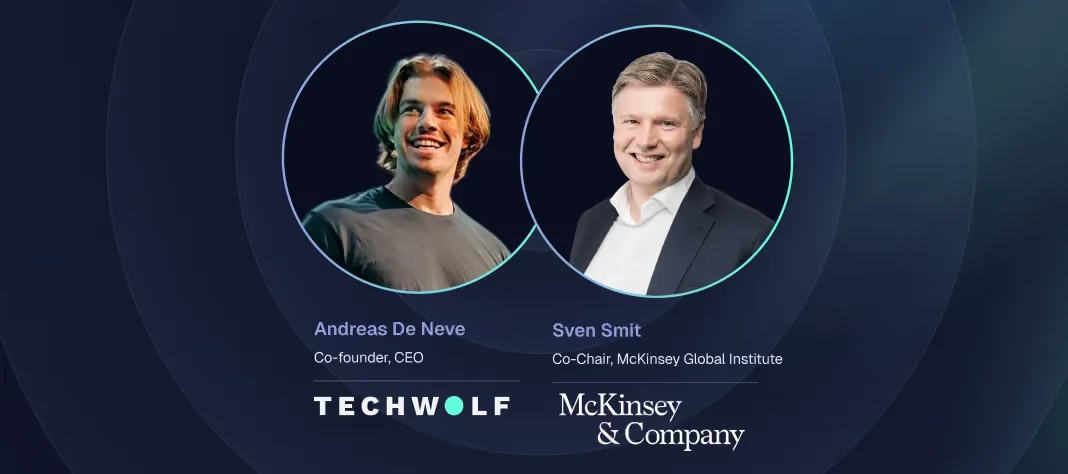
Sitting across from Sven Smit and Anu Madgavkar, I expected a conversation about automation, productivity, and the familiar AI-and-the-workforce talking points. Sven is a Senior Partner at McKinsey and Co-Chair of the McKinsey Global Institute. Anu is a Partner at MGI. Between them, they've just published Agents, Robots and Us: The Skills Partnerships in the Age of AI, and probably studied more labor-market data than anyone I've had on this show.
What I didn't expect was for the conversation to flip my mental model of the next decade of work.
In an eight and a half times economy, with 80% automation, we would actually be short people."
- Sven Smit
Not "there will be pockets of talent scarcity."
That line has stuck with me since we recorded, and I want to share why, because I think it has real implications for every CHRO and HR leader trying to plan the next five years.
The counterintuitive macro lens: more AI, more people needed
Most current forecasts, e.g. the UN, IMF, World Bank, project a global economy roughly three times the size of today's by 2100. In Sven's new book A Century of Plenty, he argues it could be eight and a half times larger, with every human on earth reaching something like Switzerland's standard of living.
Here's where it gets interesting. In that three-times economy, if AI automates 80% of current work, Sven's math says everyone would lose about two workdays a week. But in an eight-and-a-half-times economy, a world of genuine plenty, the same level of automation produces a shortage of workers, not a surplus.
Anu sharpened the point. Demographic decline is a near-certain base case: large economies are already depopulating. "Our ability to maintain wealth and security and the sense of progress is going to be a lot less in a shrinking world, relative to a world in which you have that supply shock of many more workers generating their own demand." Agents, robots, and us is a demographic story, next to a cost-reduction issue.
For HR leaders, this reframes the whole question. If you're planning a workforce strategy premised on "AI takes jobs, we need fewer people," you may be planning for the wrong century.
The fastest learner wins and planning horizons are the wrong instrument
That said, the short term is messier. About 30% of US workers are already in what McKinsey calls "agent-centric" occupations, yet fewer than 10% of enterprises say they've scaled AI meaningfully. I asked Sven where the friction sits.
His answer was pointed. Most organizations are still adding AI as features to their existing operating model: recording meetings, summarizing documents, accelerating searches. What they're not doing is redesigning the team. Give a hundred-person squad more tools and they'll produce a better outcome, but they won't come back and say they can do it with thirty percent fewer people. The companies pulling ahead are doing the opposite: make it a group of fifty, give them all the tools, and say do the same work or more in a shorter time. Forced learning inside a new operating model.
From there Sven made the point I keep returning to:
The company that will win is the company that can tell itself: I'm the fastest learner, and with that the best scaler."
The classic planning horizon (five-year strategic plan, one-year workforce plan) is the wrong instrument. What you actually need are learning metrics: what percentage of the workforce is demonstrably capable, what percentage of the work have we touched, and of that, what percentage have we actually improved?
Anu added something uncomfortable: fast learning demands cultural tolerance for failure. Eighty or ninety percent of what you try will fail. The test is whether your organization has the conviction to scale the bets that work.
The soft-skill fallacy
If there was one moment in the conversation where Sven got animated, it was around a meme floating through LinkedIn: "In the age of AI, focus on soft skills and you'll be fine."
I actually think this is one of the single biggest mistakes out there. The worst advice you could give to young people is that everything will be taken over, that we are the soft complement to the hard AI. I don't believe that for one second."
His logic is simple competition theory. If something in your environment gets dramatically smarter, you don't survive by specializing in everything it isn't. You survive by getting sharper yourself: harder problem solving, better judgment, deeper pattern recognition across the thousands of problems AI now lets you engage with.
Anu's skills-change analysis in the report backs this up empirically. The vast majority of skills, communication, problem solving, detail orientation, are shared: humans and agents both use them, often on the same workflow. The CHRO question is whether your people are super-skilling through that shared space, or whether AI is quietly absorbing the context and judgment they never got the chance to upgrade.
Tell your employees to soften up, and they lose that race. Help them harden up, and they stay in the loop.
Tasks are a trap. Workflows are the unlock.
The second strategic error Anu called out: optimizing at the task level.
"Businesses and organizations succeed or fail based on the success of workflows," she said. "When you elevate your paradigm from 'what is one worker doing?' to 'what is this whole chain achieving?', it forces the organization to reimagine what that chain could look like." In claims processing, that might mean collapsing a day of back-and-forth into five minutes. In business development, it might mean an agent scanning the market, narrowing the funnel, prepping the account manager, scheduling the meeting. All work that used to be owned by a dozen people.
And this is where the productivity gap hides in plain sight. Anu dropped a stat I hadn't heard in a while:
A small share of companies account for most of the productivity growth in any economy. In any sector, 5% of companies account for 80% of productivity growth."
The companies pulling away right now are the ones rewiring entire business processes with human validation engineered in, not the ones chasing a menu of task-level use cases.
Sven's inverse advice was just as sharp: if your only objective is to automate and take people out, you'll get it wrong. This is agents, and robots, and us.
HR's new mandate: hybrid teams, agentic onboarding, personal transformation
All of which lands on the CHRO's desk.
Anu described what "hybrid" is starting to mean in practice: onboarding agents the way you onboard humans: walking them through your company's ethics, values, norms, and cultural tone, defining their KPIs, engineering the motivation and accountability loop,...
"There is a whole realm of agentic psychology and motivation. But I'm not sure how I feel about an agentic boss."
- Anu Madgavkar
Sven argued the single biggest change in the HR role is moving from annual, transactional workforce planning to a five-year hybrid workforce architecture, one that sits in the business budget, not the IT budget. "AI is not an IT effort. It's a business effort. That's another place things go wrong."
And then, the line I keep circling back to. At a recent dinner with CHROs, Sven said, more than one told him: this is a level of change I haven't seen before, and a level of change for me personally that I haven't seen before. His challenge to every HR leader listening: what are you doing, right now, not to learn AI, but to get equipped to lead through it?
It's a question I'll be sitting with for a while. I hope you will too.
🎧 Listen to the full conversation
This is barely the half of it. We went deep on skills shared between humans and agents, why radiology is adding headcount (not losing it), and why Sven thinks the next iconic AI-era company hasn't shown up yet.
▶ Listen to the full episode here
🐺 TechWolf × McKinsey
At TechWolf, we're proud to be working alongside McKinsey on what a skills-based, AI-era workforce actually looks like and what it takes to build one. The Agents, Robots and Us report is a big part of the shared map we're drawing with them.
Blog
From guides to whitepapers, we’ve got everything you need to master job-to-skill profiles.


Mobility series: JD, from Belgium to New York to San Francisco


The friction layer (Part 2): Why the most AI-exposed function isn't the most strained

Reading the AI shift: our CTO Jeroen Van Hautte meets Benedict Evans