
From fixing data fragmentation to the "messy middle" of task automation, here is what the industry’s biggest players are actually doing.
On November 18–19, 2025, the TechWolf team joined over a hundred senior executives in Brooklyn, NY for The AI Leadership Summit, hosted by The Conference Board.
Looking back at the two days of sessions, the shift in the room was clear. The conversation has moved past the "pilot purgatory" of previous years. We aren’t asking “what can AI do?” anymore. The focus is now entirely on “how do we scale this to drive business value?”
We joined leaders from CVS Health, UPS, Microsoft, and Bessemer Venture Partners to discuss the realities of AI adoption in the workforce.
Here is what stood out.
1. AI is finally fixing the fragmentation problem
For years, enterprises have been stuck with disconnected data silos. A unified view of the employee felt impossible. According to leaders from CVS Health and UPS, AI is finally solving this.
Both companies are using AI to unify massive amounts of disconnected data, from health records to shipping history. This isn't just about better dashboards; it's about unlocking the kind of personalization that used to be manually impossible.
- CVS is shifting from broad segments to individual-level engagement.
- UPS is doing the same with delivery preferences and cross-border support.
The takeaway: The biggest impact is on employees. When AI removes low-value work, auto-summaries, smart retrieval, real-time coaching, adoption skyrockets. It simplifies the complexity so people can actually do their jobs.
2. AI won't fix a broken process
A recurring theme throughout the summit: most companies have updated their tech stacks, but their org design is still stuck in 2020.
AI amplifies what already exists. Strong processes get stronger. Weak processes break faster.
AI success depends more on people and structure than on the tool itself.
- Governance, not bureaucracy: The winners are building clear guardrails that reward smart risk-taking.
- Proactive planning: Executives predict that 50% of roles will fundamentally change within 5 years. You can’t plan for that reactively.
The next 12–36 months will define which organizations truly transform and which ones get left behind.
3. Jobs don’t get automated, tasks do
One of the highlights for us was the session featuring TechWolfs’ co-founder Mikaël Wornoo alongside leaders from Microsoft (HR Digital Strategy) and Bessemer Venture Partners.
The discussion drilled down into the "messy middle" of AI adoption.
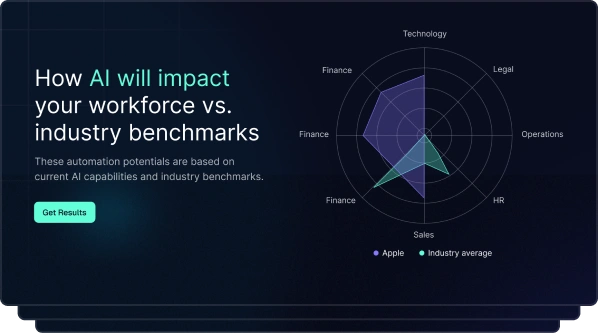
- The reality: While ~38% of tasks can be automated or augmented, roughly 75% of skills are transforming.
- The shift: If you only look at job titles, nothing seems to change. But if you look at tasks and skills, you see the real disruption.
Microsoft brought the receipts to back this up, citing ~20% efficiency gains in HR shared services and a 9.4% increase in revenue per seller in Sales. The goal isn't to cut headcount, it's to reinvest that efficiency into upskilling people to handle the new work.
4. Silence is dangerous
A critical reminder from Susan Youngblood (Bessemer Venture Partners) and the Microsoft team was the danger of poor communication.
If employees don’t know WHY AI is being used, they’ll assume the worst.
The most forward-thinking boards are now asking the right questions: “How is work changing, and what workforce data do we finally have to back big decisions?” To answer this, you need a skills engine that infers capabilities from real work, creating a profile that evolves as fast as the job does.
Closing thoughts
The message from New York is simple: AI is no longer an experiment. It is reshaping the fundamental structure of work. The companies winning today are building the right data foundation, redesigning their organizations for agility, and treating their employees as the primary beneficiaries of AI productivity.
Related videos
From guides to whitepapers, we’ve got everything you need to master job-to-skill profiles.



Using AI while interviewing at Techwolf
At TechWolf, we see generative AI as part of the modern toolkit — and we expect candidates to treat it that way too. We love it when people use AI to take their thinking to the next level, rather than to replace it.You are welcome to use tools like ChatGPT, Claude, or others during our interview process, especially in take-home assignments or technical exercises. We encourage you to bring your full toolkit — and that includes AI — as long as it reflects your own thinking, decisions and creativity.We don’t see AI as replacing your skills. Instead, we’re interested in how you use it: to brainstorm ideas, speed up iteration, validate your thinking, or unlock new ways of approaching a challenge. Great candidates show judgment in when to rely on AI, how to adapt its output, and where to go beyond it.
What we’re looking for:
Our interviews are designed to understand how you think, solve problems, and express ideas. Using AI in a way that amplifies those things — not masks them — is encouraged.
What to avoid:
We ask that you don’t submit AI-generated work without review, or present answers that you can’t fully explain. We’re not testing the model — we’re getting to know you, your skills, and your potential. If there are cases where we don’t want you to use AI for something, we’ll tell you ahead of the interview being booked.In short: use AI as you would on the job — as a smart assistant, not a stand-in.
Example: Programming with AI
In a coding challenge, you’re welcome to use generative AI to support your workflow — just like you might in a real development environment. For instance, you might use AI to quickly generate boilerplate code, look up syntax, or get a first-pass solution that you then adapt and debug collaboratively. What we’re interested in is your ability to reason through trade-offs, communicate clearly, think about complexity and iterate effectively — not whether you memorized the syntax perfectly. If using AI helps you stay in flow and focus on higher-level problem-solving, we consider that a strength. There could be some challenges where we won’t allow you to use AI - in that case we’ll tell you in advance, and will tell you why.