
What Is a Skills Data Provider? How to Choose the Right One for Your Enterprise

Every talent strategy depends on skills data. Whether you're planning workforce transformations, matching employees to internal roles, or figuring out which positions are most exposed to AI automation, you need structured, reliable information about what skills your people actually have and what skills your organization needs.
A skills data provider delivers that information. But the term covers a wide range of approaches, from static taxonomy libraries to AI-powered inference engines, and the approach you choose will shape what you can actually do with your skills data downstream.
This guide breaks down how skills data providers work, what the key differences are between approaches, and how to evaluate which model fits your enterprise.
What does a skills data provider actually do?
A skills data provider supplies structured, standardized information about workforce skills to power HR technology systems. At a minimum, a skills data provider gives you a common language for skills (a taxonomy or ontology), a way to associate those skills with people, jobs, or roles, and the ability to feed that data into your existing HR tech stack through integrations or APIs.
Where providers differ is in how they source that data, how often it updates, and how specific it can get to your organization.
Three approaches to skills data
Most skills data solutions fall into one of three broad categories. Understanding the differences matters because each approach produces fundamentally different outputs, and those outputs determine what use cases you can support.
Approach 1: Static taxonomy providers
The most established approach in the market is the curated skills taxonomy. These providers maintain a library of pre-defined skills, typically built from labor market data such as job postings and resumes. Skills are organized into hierarchical structures with synonyms, related terms, and weighted relationships.
Organizations consume this data through APIs, matching free-text job descriptions or resumes against the taxonomy to extract recognized skills.
This approach has strengths. Taxonomies provide a common language across an organization. They're well-understood, relatively easy to implement, and good at standardizing messy job title and resume data.
The limitations show up when your needs go beyond standardization. Static taxonomies require periodic updates from the provider, so they lag behind emerging skills in fast-moving fields. They typically can't capture company-specific skills or internal terminology that matters to your workforce planning. And because they rely on text extraction from documents, they only know about skills that were explicitly written down somewhere.
Approach 2: Skills management platforms
Some providers approach skills data from the learning and development side. These platforms let organizations build and manage their own skills frameworks, often paired with self-assessment tools, manager reviews, and certification tracking.
The value here is employee engagement. People actively participate in building their skills profiles, which creates buy-in and can surface skills that wouldn't appear in any job description.
The tradeoff is data quality and coverage. Self-assessments are subjective, inconsistently completed, and difficult to scale across a large enterprise. Response rates for skills surveys rarely exceed 30-40% in large organizations, and the data starts aging the moment someone completes a form.
Approach 3: AI-powered skills inference
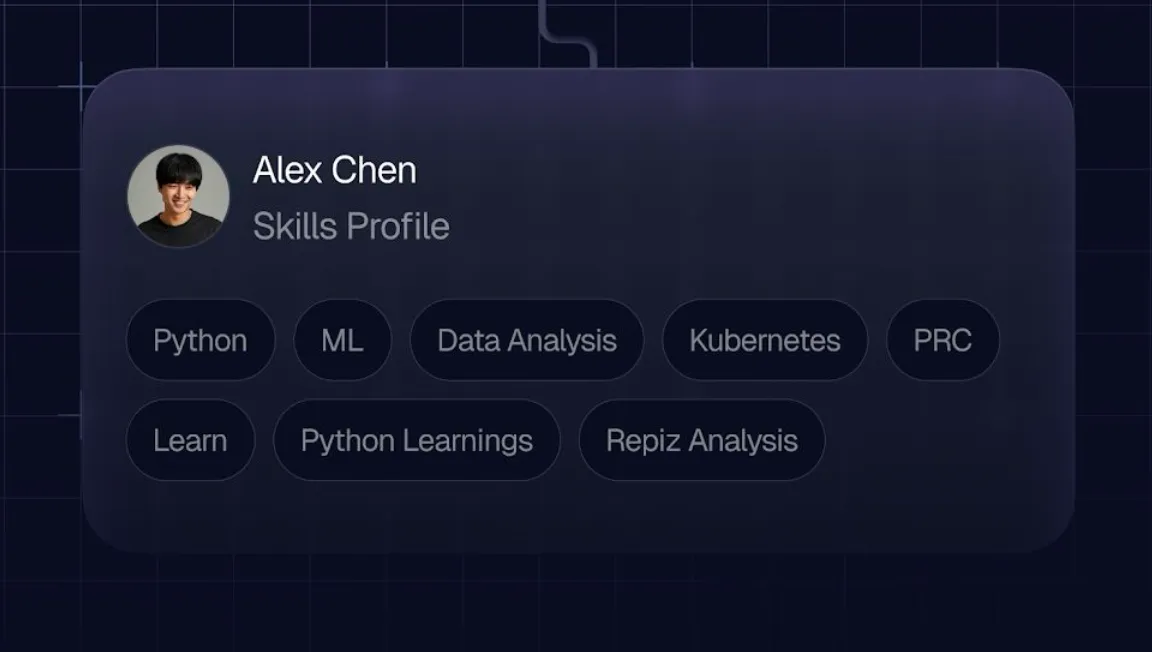
A newer category of skills data provider uses machine learning to infer skills from the data already flowing through an organization's HR systems. Rather than extracting skills from documents or asking employees to self-report, inference engines analyze signals from HRIS, ATS, LMS, and other systems to build skills profiles automatically.
This is the approach TechWolf takes. TechWolf's Skills Intelligence connects to your existing HCM platforms (Workday, SAP SuccessFactors, and others), reads the work activity data already captured there, and continuously infers skills at the individual employee level. The result is a live, organization-wide skills inventory that updates as people's roles, projects, and learning activities change.
The advantage of inference is coverage, accuracy, and freshness. Because the system works from actual work data rather than self-reports or static documents, it can build skills profiles for an entire workforce without requiring anyone to fill out a survey. At HSBC, TechWolf mapped over 250,000 employees into a unified skills taxonomy within five months.
How AI-powered skills inference works
TechWolf's inference engine is built on purpose-built AI models trained specifically for the HR and workforce domain. These are not generic large language models. TechWolf's models are trained on over 2 billion job postings, giving them deep understanding of how skills relate to actual work.
The process works in several stages.
First, the system ingests data from your HR systems. This includes job architecture data (titles, descriptions, reporting lines), learning data (completed courses, certifications), talent acquisition data (requisitions, candidate profiles), and other workforce signals your systems already capture.
Second, TechWolf's models analyze those signals to infer which skills are associated with each employee, role, and team. This goes beyond keyword matching. The models understand that a "Senior Cloud Infrastructure Engineer" and a "Staff Platform Reliability Architect" share significant skill overlap, even though the titles share zero words.
Third, inferred skills are validated. TechWolf pushes skills suggestions to employees and managers for review, combining AI precision with human judgment. This keeps people in the loop while maintaining the scale that only automation can deliver.
Finally, the validated skills data flows back into your HCM, populating Workday Skills Cloud or SAP SuccessFactors, where talent decisions actually happen. This means skills intelligence becomes embedded in your existing workflows rather than living in a separate tool.
What to look for when choosing a skills data provider
Not all organizations need the same approach. Here are the questions that matter most when evaluating providers.
How does the provider source its skills data?
This is the most important question, and the one that separates providers most clearly. Ask whether the data comes from a pre-built library, from employee self-reports, or from automated inference on your actual workforce data. Each approach produces different levels of coverage, accuracy, and organizational specificity.
How frequently does the data update?
Skills are not static. In technology-heavy domains, the relevant skill landscape can shift meaningfully within a single quarter. Providers that depend on periodic taxonomy releases or annual skills surveys will always lag behind the actual state of your workforce. Look for providers that can deliver continuous or near-continuous updates.
Can the provider capture skills specific to your organization?
Every enterprise has internal skills, tools, and competencies that don't appear in any public taxonomy. If your organization uses a proprietary technology stack, operates under industry-specific regulatory frameworks, or has roles that don't map neatly to standard job families, you need a provider that can identify and incorporate those organization-specific skills.
How does the provider integrate with your existing HR systems?
Skills data is only valuable if it reaches the systems where talent decisions are made. Evaluate whether the provider integrates natively with your HCM (Workday, SAP, or others), or whether integration requires significant custom development. Native integrations reduce implementation time and ensure that skills data stays fresh across systems.
What is the provider's data governance and compliance posture?
For global enterprises, data governance is non-negotiable. Look for providers with ISO 27001 certification, ISO 42001 (AI management system) certification, and demonstrated compliance with regulations like the EU AI Act. TechWolf holds both ISO 27001 and ISO 42001 certifications, and its inference models are designed to produce bias-free, auditable skills data.
TechWolf as a skills data provider
TechWolf is a skills intelligence platform purpose-built for large enterprises. The platform connects directly to your HCM, continuously infers skills from actual work activity, and delivers a live skills inventory that powers workforce planning, internal mobility, skills-based hiring, and AI transformation strategies.
Here is what TechWolf delivers as a skills data provider:
Automated skills profiles at scale. TechWolf builds skills profiles for every employee in your organization by analyzing data from your HRIS, ATS, LMS, and other systems. No surveys, no manual data entry, no gaps in coverage.
Continuous updates. Skills profiles refresh as employees change roles, complete learning, or take on new responsibilities. Your skills data stays current without requiring periodic re-assessments.
Organization-specific skills. TechWolf's models identify skills unique to your business, including proprietary tools, internal methodologies, and domain-specific competencies that wouldn't appear in a generic taxonomy.
Native HCM integration. TechWolf integrates directly with Workday and SAP SuccessFactors, populating skills data where your HR teams already work. No separate login, no additional tool.
Enterprise-grade security and compliance. ISO 27001 and ISO 42001 certified. Designed for organizations operating under strict data governance requirements, including EU AI Act compliance.
Enterprises including HSBC, Ericsson, Workday, and GSK use TechWolf to power their skills strategies. At Workday, TechWolf's skills-based hiring approach contributed to a 15% faster time-to-hire.
For practitioners: try skills inference with JobBERT
If you work in people analytics or HR data science and want to explore what AI-powered skills inference looks like in practice, TechWolf maintains an open-source model called JobBERT on Hugging Face.
JobBERT is a multilingual sentence-transformer model trained on over 21 million job title and skills pairs across English, Spanish, German, and Chinese. It can infer approximate skill associations from job titles alone, with roughly 60-70% accuracy.
It's a useful starting point for technical teams who want to experiment with skills inference on their own data before evaluating a full enterprise solution. You can use it to test skill matching across job titles, explore how multilingual job roles map to similar skill clusters, and prototype skills-based analytics.
JobBERT is freely available under an MIT license and has been downloaded over 1,500,000 times. It represents a simplified version of what TechWolf's full inference engine does at production scale. The enterprise product adds company-specific model training, multi-source data ingestion, human validation workflows, and native HCM integration, capabilities that go well beyond what an open-source model can deliver on its own.
Frequently asked questions
What is the difference between a skills taxonomy and a skills data provider?
A skills taxonomy is a structured list of skills, organized into categories with relationships between them. A skills data provider can include a taxonomy but also delivers the ability to associate those skills with your actual workforce. Some providers focus primarily on the taxonomy itself, while others (like TechWolf) focus on generating skills data from your organization's real activity data.
Can a skills data provider work with my existing HCM?
Yes, but integration depth varies significantly by provider. Some providers offer standalone APIs that require custom development to connect with your HR systems. TechWolf integrates natively with Workday and SAP SuccessFactors, meaning skills data flows directly into your existing HCM without requiring a separate platform.
How accurate is AI-inferred skills data?
Accuracy depends on the quality of the underlying models and the richness of the input data. TechWolf's purpose-built models, trained on billions of job postings and validated against real workforce data, deliver high-precision skills profiles. The system also includes human validation, where employees and managers review and confirm inferred skills, adding an additional layer of accuracy.
How long does it take to implement TechWolf?
TechWolf can deliver live skills data within weeks of connecting to your HCM. Full end-to-end implementation, including data integration, model tuning, and employee validation workflows, typically takes a couple of months. TechWolf built a skills intelligence system for HSBC's 250,000+ employees in five months.
Is TechWolf suitable for mid-market companies?
TechWolf is built for large enterprises, particularly organizations with complex workforce structures, multiple HR systems, and global operations. The platform is used by Fortune 500 companies and large public-sector organizations. If you're a smaller organization looking to explore skills inference, TechWolf's open-source JobBERT model is a good starting point for technical experimentation.
Explore the Skills Intelligence Index
Discover how 2,500+ skills connect to tasks, AI impact, and each other.
Blog
From guides to whitepapers, we’ve got everything you need to master job-to-skill profiles.
Start with the work: why Colt chose TechWolf to build its skills foundation


Getting skills right: Why demand and supply must always be on


The friction layer (Part 2): Why the most AI-exposed function isn't the most strained