Why we’re open-sourcing our AI-First bootcamp

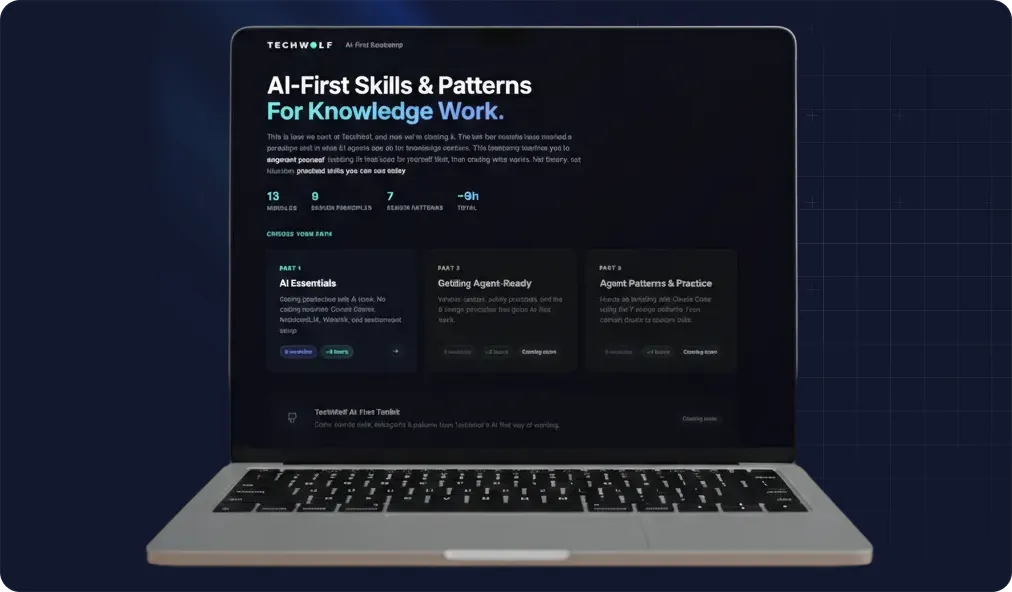
At TechWolf we’re more than aware that AI is transforming work. In fact, it’s the story we tell the world’s biggest employers every day: we all need to navigate this revolution and make sure our workforce is ready to embrace AI to automate or augment the right tasks and workflows.
So we practice what we preach. And we ran our first AI-first bootcamp at TechWolf. After the two-day training, the questions started piling up. Not about the results, though those were good. People wanted the playbook: what did you teach, in what order, how did you make it stick, and how can I jump on board?
We got asked often enough that our Technology Specialist Lennert De Mey and I decided to just put it out there.
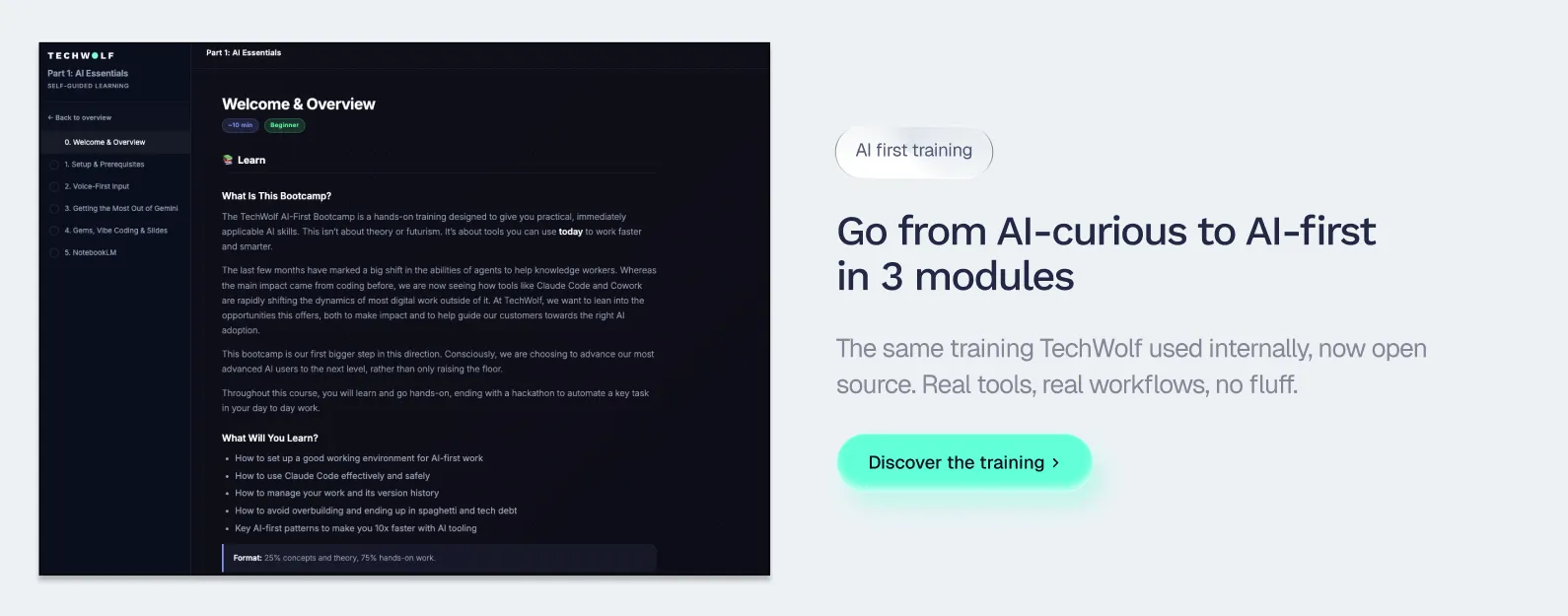
So here it is, today we’re open-sourcing the first part of the training: https://ai-first.techwolf.ai/
Raising the ceiling, not the floor: not another “how to prompt” course
I’ve written before about raising the ceiling instead of the floor. The short version: instead of making everyone 3% better by giving them access to ChatGPT, we wanted to create champions who show the rest of the company what’s actually possible.
So we picked eight people from HR, marketing, product, finance, and customer success. Gave them the most capable tools available. Spent two full days re-engineering their actual work. Not slides about prompting. Not a walkthrough of features. Real problems, real data, real workflows.
By the end, each of them had built something they used on Monday morning. A document reviewer. A customer signal aggregator. A content research pipeline. To become AI-First Certified at TechWolf, you don’t just pass a quiz. You ship something real.
The multiplier effect
The people who went through this course went back to their teams and have now started pulling others forward. Showing a real tool that solves a real problem makes the possibility feel concrete. People who had been skeptical became curious. People who had been curious started building.
That multiplier effect is the whole point. The best people want to work in environments where AI creates leverage for them to do what they’re best at. Give them that environment, and they pull everyone else along.
The training itself is a proof of concept
Here’s my favourite thing about this release.
After the two days were over, we had recordings, transcriptions, live discussions, and a pile of raw notes. We started with a skeleton training structure, basically an outline of what we covered. Then we did exactly what we’d been teaching: we used AI-first principles to transform all of that into a full interactive resource.
We took two days of messy, unstructured experience and turned it into something anyone can follow: a self-guided training with steps, questions and even a quiz for every part. Something that would have taken months to build the traditional way came together in a fraction of that time, using the same tools and techniques the bootcamp itself covers.
The medium is the message. If a training about AI-first work wasn’t itself built in an AI-first way, we’d be doing it wrong. The fact that it was is probably the strongest argument for what’s inside it.
What the data tells us on AI-first work
At TechWolf, we’ve analyzed over 2 billion job vacancies across more than 1,500 enterprises through our Work Intelligence Index. When we initially started looking at AI-first work internally, we used task data like what we provide through our Work Intelligence product to understand where AI can make the biggest impact, and how to make that impactful for the people actually doing the work.
The number that stands out: 38% of knowledge work tasks are being significantly disrupted by AI right now. But look at what that 38% is made of. Only 18% of tasks are fully automated. The rest is augmentation, work that humans and AI do together better than either does alone.
A human-centric approach to AI is key, and we keep this focus throughout our AI training.
Why open source, why now?
We want to show the way in terms of AI-first work. Both through the data we provide and the example we set. When our own data tells us that 38% of knowledge work is being disrupted, holding back a roadmap for navigating that feels like a contradiction.
TechWolf’s mission is to help every person flourish at work. Not every company. Every person. That’s harder to deliver if the knowledge that enables it stays inside one organization.
There’s also a practical reason. This course gets better the more people use it, push against it, and build on it. A course that stays inside one company stays static. One that goes into the world gets sharper, and helps more people along the way.
We’re releasing it in parts because we’ve noticed it takes digesting. We’re also still improving and iterating on each section, polishing in places where the models left some rough edges. But the full collection will be available soon.
Part 1 is live, part 2 and 3 are coming in a few days
The training comes out in three parts:
- Part 1: AI Essentials. Individual productivity. Voice tools, research tools, building with AI without writing a line of code. This is live now.
- Part 2: Getting Agent-Ready. AI-first design principles and engineering standards. The layer that turns individual productivity into repeatable, scalable practice. Comes with an open source companion kit: skills and plugins for Claude Code and Cursor, built directly on these principles.
- Part 3: Agents Patterns & Practice. Building and shipping custom tools from scratch. We close with a showcase from our internal hackathon, including an open source release of the winning project: a fully autonomous tool built by a non-engineer using exactly this stack.
The playbook is here, we’ll improve it in the open
People asked for the playbook, so here it is. It’s not a finished product. We know it has gaps, and we’re still finding the edges of what works and what doesn’t.
The best version of this gets built in the open.
If you go through it and find something missing or something that could be sharper, we want to know.
Contact us via lennert.demey@techwolf.ai
Blog
From guides to whitepapers, we’ve got everything you need to master job-to-skill profiles.

You're preparing for the wrong AI event

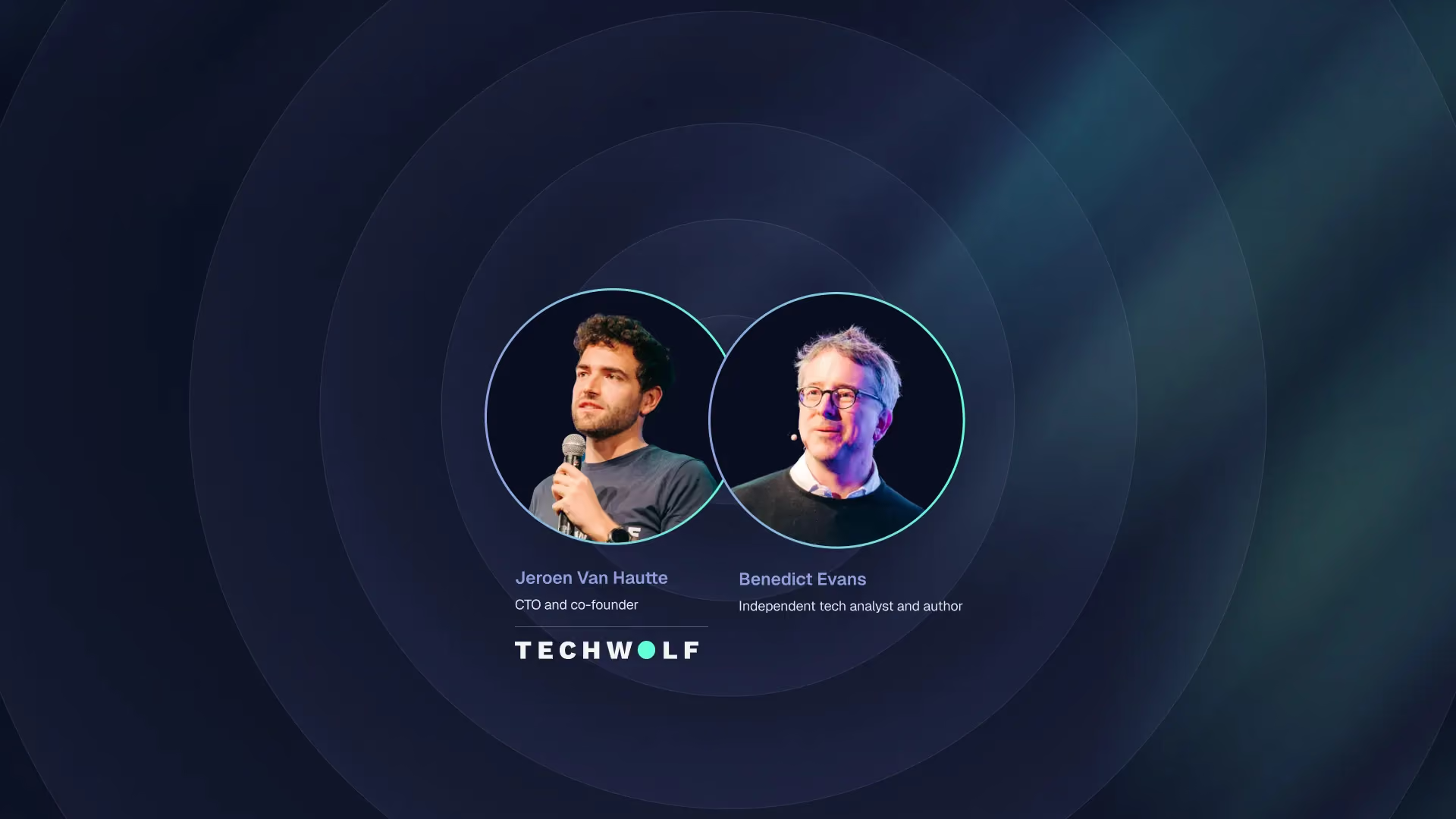
Reading the AI shift: our CTO Jeroen Van Hautte meets Benedict Evans
McKinsey x TechWolf on AI, agents, and the next decade of work