
The friction layer: Where structural AI pressure actually lands

Overview
TechWolf's Skills Intelligence Index analyses over two billion job postings from 1,500+ companies worldwide, mapping the tasks people perform and scoring each for AI impact using the Stanford Human Agency Scale.
For this piece, Endeavor Intelligence, an independent research firm, took that data and asked a different question: how does AI pressure move across functions through shared skills? We call the place where that pressure concentrates the friction layer: the functions where the way work is organised is under the most structural strain from AI-driven change.
Those are smaller, less prominent, and nowhere on most AI steering committees' agendas.
They are DevOps & SRE, Finance, and QA & Testing. Software Engineering is over three times their combined size. On structural AI pressure, it ranks seventh.
The picture everyone already has
The Skills Intelligence Index scores every task using the Stanford Human Agency Scale, an academic framework that evaluates work across dimensions like cognitive complexity, empathy, and ethical sensitivity. Every task receives one of three labels.
Human: work that requires fundamental human judgment, like managing a difficult client relationship or making an architectural design decision.
Augmentable: work best performed through human-AI collaboration, like reviewing code with an AI assistant or analysing data with AI-generated summaries.
Automatable: structured work that AI can handle with minimal human input, like running standardised test scripts or reconciling routine invoices.
Across the full dataset, roughly 63% of tasks remain human-led. About 37% are delegable to AI, with augmentation outpacing full automation by roughly two to one. Every function has its own version of this breakdown.
That is the surface picture: useful, but incomplete. It treats every function as an island. Functions are not islands.
AI doesn't reshape work at the level of job titles or functions, it reshapes it at the level of skills. That's why the connective tissue between functions only becomes visible once you measure work at that resolution. With two billion postings as the substrate, the pressure flowing between functions stops being anecdotal and starts being measurable."
— Jeroen Van Hautte, CTO at TechWolf
What the surface picture cannot see
Functions share skills. Not in theory. In practice.
Consider DevOps. A DevOps team shares capabilities with software engineering, security, data infrastructure, and operations. The same skills show up across all of them. When an AI-powered tool reshapes how code gets tested and deployed, the effect does not stay inside DevOps. It touches the engineers who write the code, the security teams who scan it, the QA teams who validate it. The change ripples outward through every function that depends on the same skills.
DevOps does not just face its own AI exposure. It absorbs the knock-on effect of AI-driven change hitting every adjacent function's overlapping skills. And DevOps shares skills with more functions than almost any other in the dataset.
The structural question is how much pressure flows through a function from everywhere else: shared skills being reconfigured around human-AI collaboration, not yet resolved, not yet absorbed. A function can look manageable on the surface and sit under enormous structural pressure, because its skills are woven into the fabric of half the organisation. The surface picture cannot see this. It was never designed to.
Measuring what flows beneath the surface
To measure this, we looked at two things for every function. How much pressure arrives, and from how many directions: a function where 40% of tasks are delegable to AI is one thing; a function where those tasks involve skills shared across six other functions absorbs pressure from across the organisation. And when pressure arrives, does the function have room to adapt: if the delegable work mostly benefits from human-AI collaboration, there is room to redesign workflows; if it tilts toward full automation, that room shrinks.
When both converge, high cross-boundary pressure and limited room to adapt, we call that undercurrent tension. It is invisible to standard workforce analysis, but measurable when you trace how skills connect across functions. This is a structural map of where the way work is organised is under the most pressure to change.
The functions absorbing the most structural pressure are almost never the ones on the AI steering committee's agenda. That's not a coincidence, it's a blind spot. Any workforce strategy that stops at the function level will keep missing where the strain actually shows up first, and keep applying the wrong playbook when it does."
— Markus Bernhardt, Principal at Endeavor Intelligence
Where pressure actually concentrates
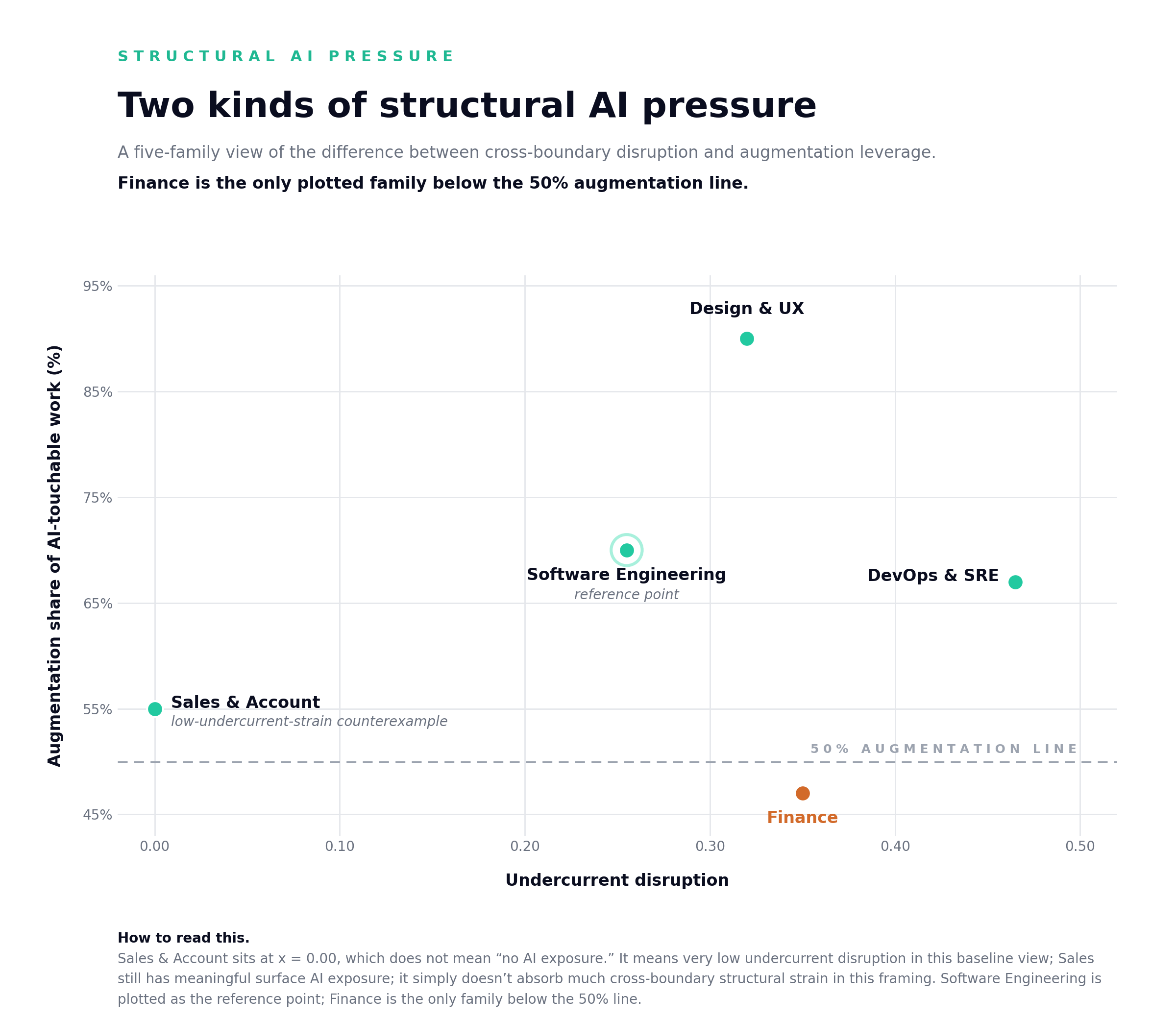
DevOps & SRE carries the highest structural tension in the dataset. QA & Testing is second. Finance is third. Software Engineering is seventh.
For comparison: Sales & Account Management is the second-largest function in the dataset. Its structural tension is the lowest of any function in the dataset. Not because Sales is isolated. It shares real skills with Product, Strategy, and even Software Engineering. But the skills that dominate its mass remain heavily human-led and commercially concentrated. The overlap is real. The structural pressure through it is not.
Integration pressure: DevOps and QA
DevOps and QA are the connective tissue of the technology organisation. Their skills touch software engineering, security, data infrastructure, and operations simultaneously. When AI changes how testing, deployment, monitoring, or integration work in any adjacent function, DevOps and QA absorb that pressure first. They sit at the intersection.
On the surface, both functions look manageable. Their share of human-led work is close to the dataset average. The surface picture would place them in the middle of the pack.
The structural picture puts them at the top.
Critically, of the AI-delegable work in both functions, roughly two-thirds is the kind that benefits from human-AI collaboration. The pressure is real. The room to adapt through redesign is also real. The pressure these functions face concerns how work flows across the organisation changing faster than the organisational structure can keep up. The skills are shifting. The workflows that depend on those skills are shifting. The org chart has not moved.
Finance inverts the pattern
Finance tells a fundamentally different story. It is the only function in the dataset that falls below the 50% augmentation line on this chart. That means more of its AI-delegable work is the kind AI can handle end to end than the kind that benefits from human-AI collaboration.
Three signals converge in Finance, and they do not converge in any other function.
Fewer than half of Finance tasks require the kind of judgment, empathy, or creativity that AI cannot replicate, the lowest share of human-led work in the dataset. The balance between augmentation and automation tips toward automation: for every task where human-AI collaboration is the best approach, there is more than one where AI could handle the work alone. In DevOps and QA, that ratio is reversed by more than two to one. Finance inverts the pattern seen everywhere else in the dataset, and its automation readiness score is the highest of any function. No other function carries all three simultaneously.
What surprised me most in this analysis isn't where the pressure concentrates, it's how invisible it is to the standard view. A function can look healthy on every workforce dashboard while sitting under real structural strain. That gap between what's visible and what's actually happening is a measurement problem, and it's the one we set out to close."
— Jeroen Van Hautte, CTO at TechWolf
Two patterns, two responses
Finance and DevOps face fundamentally different kinds of pressure. DevOps and QA face integration pressure: structural tension driven by persistent, cross-boundary transmission through shared infrastructure skills, with strong augmentation leverage that gives organisations room to redesign workflows around human-AI collaboration. Finance faces automation exposure. It carries real structural transmission through shared analytical and control skills, but its automation-heavy profile leaves it with less room to absorb the pressure that does arrive. The strain is high not because the incoming pressure is the largest, but because the cushion is the thinnest.
Integration pressure calls for operating model redesign: rethinking who owns cross-functional workflows, how shared skills are governed, and how work gets structured as AI enters the collaboration layer. Automation exposure calls for a harder conversation about workforce restructuring, task reallocation, and what happens to a function where the human core is smallest and the automatable share is largest.
Applying the same playbook to both would be a mistake.
Why this matters
Every CHRO right now is being asked by their CEO where AI will hit them first. They tend to answer at the function level, because that's the only data they have. The contribution of this analysis is that it lets you answer the question at the level where work actually happens, between functions, through the skills they share."
— Markus Bernhardt, Principal at Endeavor Intelligence
These three functions are where AI strategy meets organisational reality.
If you are building an AI workforce strategy today, chances are it starts with the surface picture: which functions have the most automatable tasks, where are the biggest efficiency gains, where should the next pilot land. That picture is real and it is useful.
This analysis suggests it is not sufficient. The functions absorbing the most structural pressure are smaller, less visible, and unlikely to appear on an AI steering committee's agenda. DevOps, QA, and Finance sit in a governance blind spot. They are smaller, less prominent in the AI conversation, and carrying measurably more structural tension than Software Engineering.
Two things follow. First, workforce planning needs structural data alongside surface-level exposure scoring. Knowing that 37% of tasks across the organisation are delegable to AI tells you the scale of AI's potential reach. It does not tell you where the way work is organised will come under pressure first.
Second, the response has to match the pattern. Functions under integration pressure need workflow redesign and cross-functional governance. Functions under automation exposure need a different kind of strategic attention entirely.
The surface tells you what AI can do. The structural picture tells you where the organisation will feel it first. These three functions are the friction layer: the place where the way work is organised meets the structural reality of AI-driven change. They are where the conversation needs to start.
How this analysis works
This analysis combines two inputs. TechWolf's Skills Intelligence Index provides the data: 2,500 skills derived from workforce intelligence covering over two billion job postings across 1,500+ companies (2015 to 2025). Each task is classified using the Stanford Human Agency Scale, a framework developed at Stanford University that categorises tasks as Human, Augmentable, or Automatable based on dimensions including cognitive complexity, empathy, and ethical sensitivity.
Endeavor Intelligence provides the structural analysis: mapping TechWolf's skill-level data to 17 job families through a transparent, rules-based taxonomy, then computing how AI pressure propagates across functions through shared skills. The full methodology, indicator definitions, and sensitivity testing are published in The Undercurrent in Data, an independent Endeavor Intelligence report available at here.
What this analysis does not do: predict job losses, attribute causation, or claim that AI will replace specific roles.
Data: TechWolf Skills Intelligence Index. AI impact framework: Stanford Human Agency Scale. Structural analysis: Endeavor Intelligence (independent; no editorial control by data provider).
This analysis was co-published with Endeavor Intelligence.
Blog
From guides to whitepapers, we’ve got everything you need to master job-to-skill profiles.

HR's time to lead, and the data to do it: our UNLEASH Paris 2026 takeaways


Start with the work: why Colt chose TechWolf to build its skills foundation


Getting skills right: Why demand and supply must always be on
