
Reset and rebuild: how a global digital platform rebuilt talent mobility from the skills data up.


Employee-side skills inferred into one reconciled view
The organization reframed talent mobility as a data problem rather than a UI problem, successfully unifying fragmented systems into a single source of truth for its pilot population.
SME-validated accuracy on inferred skills
High-quality data built SME and employee trust quickly. Validation happened in a lightweight evaluation tool with 76% completion in the early-adopter pilot, setting the foundation for embedding skills inside the HCM system next.
Skill accuracy on AI-generated career frameworks
TechWolf delivered 9 pilot frameworks across 94 job codes with 99% skill accuracy and 87% proficiency-level accuracy. Talent Management and craft owners transition from authoring frameworks manually to validating AI-generated drafts.
Business context
The customer is a leading global, digital-first platform business. Thousands of employees work across multiple regions to run a product that lives or dies on speed. Their talent strategy has to keep pace with that product.
For several years, that strategy leaned heavily on a first-generation internal talent marketplace: a destination where employees were meant to log in to find projects, mentors and new roles. Adoption was uneven. In mid-2024, the marketplace was sunset, and the HR leadership team used the moment to ask a different question. What would it take to make talent mobility work without a separate destination at all?
Their conclusion: the problem had never been the UI. It had been the data underneath. Skills were fragmented across 40+ career frameworks, each one owned by different HR business partners, maintained by hand in spreadsheets and slide decks. Without a clean skills layer, every downstream process (career conversations, Strategic Workforce Planning, learning) ran on unreliable ground. The team decided to rebuild the foundation first.
The challenges
1. Rebuilding credibility after a marketplace sunset
When a high-visibility HR tool is deprecated, the HR function absorbs the credibility cost. The next investment needed to be obviously different from what came before, and an employee-facing UI was no longer the right answer.
2. Career frameworks maintained by hand
More than 40 career frameworks lived in spreadsheets and presentation decks. Each one was maintained by a different HR business partner on the side of their desk. The frameworks were inconsistent, often out of date, and invisible to the cloud HCM that was supposed to be the system of record.
3. Skills data that did not reconcile
Skills appeared on both the demand side (open roles, job descriptions) and the supply side (employee profiles, performance records). The two sides did not match. Leaders could not answer a simple question: instead of hiring outside, do we already have the skills we’re looking for inside the company?
4. Learning spend that could not close the loop
The enterprise LMS held thousands of courses. It could not connect them to measurable skill outcomes. Learners finished courses, and nobody could prove the skill had actually been acquired. The CFO saw the spend, the CHRO saw the completions, but nobody could see the skill.
How TechWolf helped
TechWolf is the intelligence layer underneath the customer's existing HR tech. It does not replace their cloud HCM or their LMS. It makes both smarter by supplying them with a clean, continuously updated view of the skills inside the organization. The engagement follows the three pillars of TechWolf's approach.
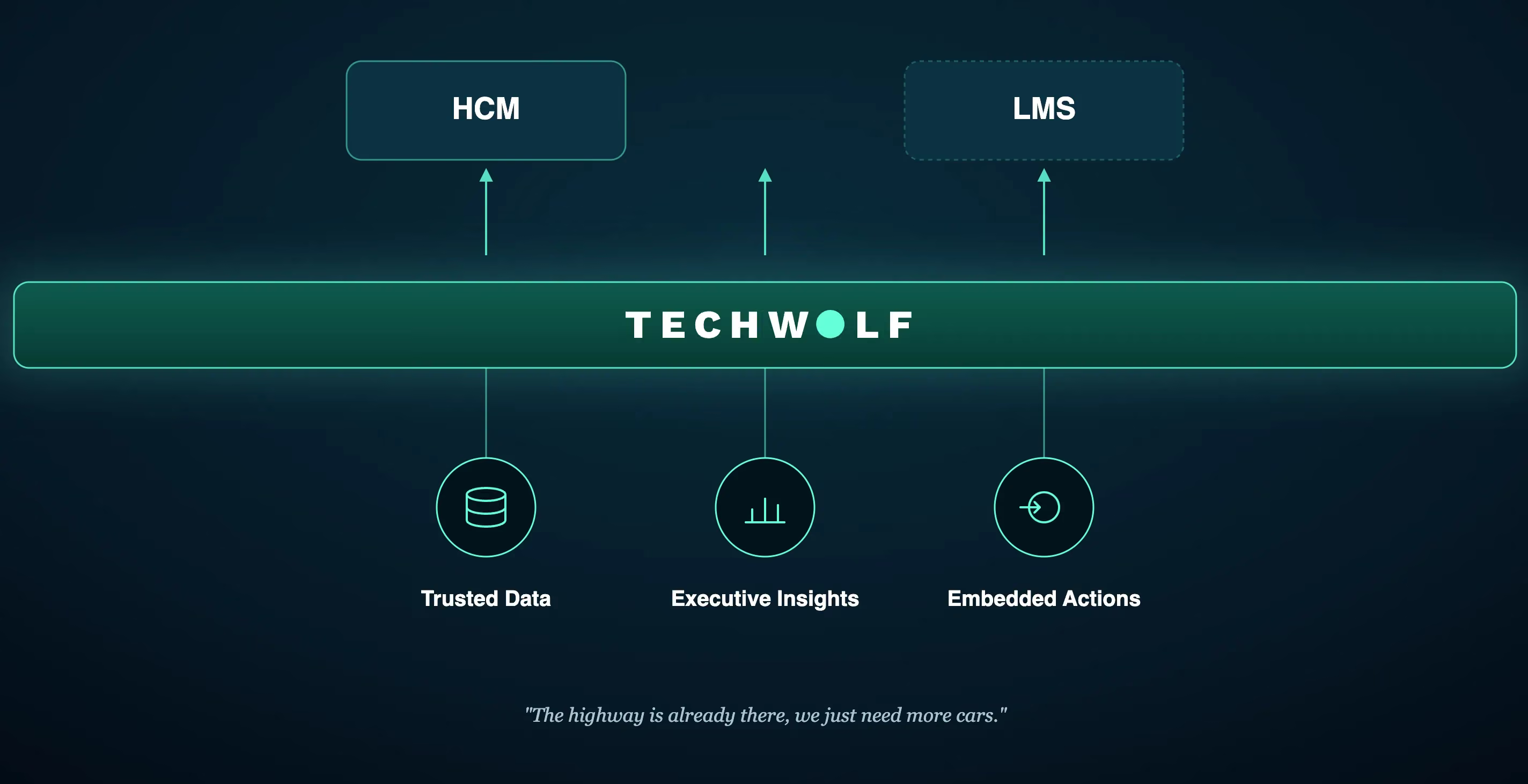
1. Trusted Data
TechWolf's inference engine reads job descriptions, role profiles and internal documents, and it produces a unified skills view that subject-matter experts then validate inside the cloud HCM. Because the validation happens in a surface HR business partners already uses, there is no new tool for anyone to learn.
In the pilot, 80 to 90 percent of inferred skills were accepted by SMEs on first pass. Proficiencies were recently added to the scope, and the team is currently working through the accuracy pass on that dimension. A single reconciled skills view now links what the company is hiring for on the demand side to what the company already has on the supply side.
2. Executive Insights
With a clean skills layer coming online, Strategic Workforce Planning can move from headcount into capability. The program reconciles roughly 3,000 skills on the demand side with 11,000 on the supply side. That reconciled view sets the table for the conversations the leadership team wants to have in 2026: where are we under-supplied, where are we over-hiring, which skills will be reshaped by AI. SWP is actively being scoped with the skills layer as the input.
3. Embedded Actions
A skills layer is only as useful as the actions it triggers. Career frameworks live inside the cloud HCM rather than as PDFs in a shared drive. Employees and managers meet them in the regular flow of their career conversations, not as a separate destination they need to remember to visit. The pilot is complete; full rollout across the catalogue is underway.
Learning is the next pillar in the roadmap. The team has a substantial course-to-skill asset (approximately 30,000 mappings) that has not yet been actioned through the enterprise LMS. An integration to serve skills-informed learning recommendations is in scoping for 2026, with the long-term goal of closing the loop from skill gap, to relevant course, to validated uplift back into the employee profile.
The highway (HCM and LMS) is already there, we just need to have more cars (data)."
— Global hrtech/ skills Lead
Outcomes so far
A skills foundation the wider HR function can start to lean on
40+ career frameworks are in program scope, with the pilot complete and the full rollout in flight. HR business partners are moving from framework maintainers to framework validators, which is the shift the team was sized to deliver a 60 to 80 percent reduction in manual maintenance effort against. Early readings are tracking toward that range.
A reconciled skills view at scale
Roughly 3,000 skills on the demand side are now reconciled against 11,000 on the supply side. For the first time, the HR and People Analytics teams share a single view of the capability pockets in the organization and where gaps are forming. SWP is being designed on top of that view.
A learning loop that can close, in the next phase
The course-to-skill asset (30,000 mappings) is staged and waiting. The work in 2026 is to connect it to the enterprise LMS so that learning leaders can report at skill level, not only at course level, and so that employees see recommendations aligned to their real gaps.
The whole goal of all of these projects is strategic workforce planning. So everything feeds into strategic workforce planning.”
— Director HRtech
Governance
The skills foundation is governed through a light, deliberate model. HR business partners act as subject-matter validators inside the cloud HCM and keep the long tail of the skills taxonomy honest, without returning to the manual maintenance that characterised the pre-TechWolf era. The HR Technology team owns the architecture and integration pattern. The People Analytics team owns the SWP outputs. Review cycles are quarterly, because the data itself is continuous.
Project challenges and how they are being resolved
Earning credibility after the marketplace sunset
Rolling out a new skills investment right after a deprecated marketplace meant the team needed to be thoughtful about what employees saw. Rather than launch another employee-facing tool, they kept the skills layer invisible and let it show up inside the HCM surfaces employees were already using. Adoption risk came down because the change was largely architectural, not behavioural.
Reconciling two different skill views across hiring demand and employee supply
The demand side of the taxonomy (from job descriptions and open roles) and the supply side (from employee profiles and records) grew to meaningfully different sizes. The team worked through this by aligning the two views at the ontology layer inside the inference engine, and then layering SME validation over the top. The result is a single view that HR and People Analytics can share, without either team owning a manual cleanup cycle.
Change management for HR business partners
Framework ownership had been distributed across dozens of HR business partners over many years. Rather than centralise ownership, the team kept HRBPs in the loop as validators. The time savings accrued to the same people who had previously carried the manual burden, which is why the change management landed: the change was in their favour.
What is next
Three tracks of work for 2026:
- Complete the career-framework rollout across the full function catalogue, so every employee in every role has a living, skills-based framework inside the HCM.
- Embed the skills layer into Strategic Workforce Planning, so leadership can model scenarios (buy, build, borrow, bot) on capability rather than on headcount.
- Scope and deliver a skills-to-learning integration with the enterprise LMS, closing the loop from skill gap, to targeted learning, to validated uplift.
Let’s get talking
We believe great conversations lead to great solutions. Let’s connect and see how we can help.

%201.jpg)

SAP Successfactors

Degreed

Visier
Workday
ServiceNow

Workday
Workday
Visier
.avif)
Workday



.svg.avif)
SAP Successfactors
SAP Successfactors


SAP Successfactors
Degreed
SAP Successfactors

Workday