
AI for workforce planning: why your planning tools are only as good as your skills data

Gartner reports that 60% of HR leaders plan to increase investment in AI-powered workforce planning tools by 2027. The budgets are moving. The technology exists. Yet most organisations still can't answer a basic question: which skills do we have, and which do we need?
That disconnect isn't a technology problem. It's a data problem.
Organisations are layering sophisticated AI planning tools on top of skills data that's incomplete, outdated, or self-reported. The result: plans that look precise but rest on shaky foundations. Confidence without accuracy. Precision without truth. Boards making multi-million euro transformation commitments based on data their own HR teams wouldn't trust.
This piece unpacks why AI for workforce planning fails without skills intelligence. It explores what TechWolf's Work Intelligence Index reveals about AI's real impact on jobs, and where to start building a foundation that works.
The AI planning paradox
Spending on workforce planning technology has never been higher. McKinsey's 2024 research on AI adoption shows that 72% of organisations have deployed AI in at least one business function. HR is catching up fast.
But investment alone doesn't solve the planning puzzle. A 2025 Mercer study found that 98% of CEOs plan workforce transformations driven by AI. The ambition is there. The readiness is not.
The more sophisticated your planning tools become, the more they depend on high-quality skills data to function. Feed them incomplete data, and they'll produce confident-looking plans built on assumptions rather than evidence.
Most workforce planning today still relies on three fragile inputs: job titles, org charts, and self-reported competencies. None of these capture what people can do. Job titles describe hierarchy, not capability. Org charts show reporting lines, not skill adjacencies. Self-reported competencies? Deloitte research found that 65% of employees can't accurately describe their own skills.
This is the AI planning paradox. Organisations are spending more on planning technology while neglecting the data foundation that makes it work. It's like upgrading your GPS while refusing to update the maps.
The consequences show up in boardrooms. CHROs present AI-readiness assessments built on fragile data. CFOs approve transformation budgets without visibility into existing capability. CEOs announce reskilling commitments without knowing which skills their workforce already has. The tools produce dashboards. The dashboards produce confidence. But the confidence isn't earned.
Planning tools can't plan what they can't see. Right now, most organisations are planning blind.
What the data shows
The scale of AI's impact on work is often overstated in headlines and understated in boardrooms. TechWolf's Work Intelligence Index, built from analysis of 2 billion+ job postings across 1,500 companies, cuts through the noise using task-level analysis grounded in Stanford's Human Agency Scale.
Of all tasks analysed across the global workforce, 18% are automatable by current AI. That's significant, but not existential. Meanwhile, 62% of work remains fundamentally human: tasks that require judgment, empathy, creativity, and contextual decision-making that AI can't replicate.
The real story sits in between. 38% of all tasks face some level of AI impact, but the majority of that impact is augmentation, not replacement. Workers won't lose their jobs to AI. They'll need to do their jobs differently.
This reframe matters enormously for workforce planning. If your planning model treats AI as a headcount reduction exercise, you'll miss the larger opportunity. The organisations that gain competitive advantage won't automate the most roles. They'll reskill and redeploy faster than the market shifts.
75% of Fortune 500 technology companies have significant untapped reskilling potential within their existing workforce. The talent is already there. The skills intelligence to activate it is what's missing.
The skills data problem
If skills intelligence is the foundation for AI workforce planning, why don't most organisations have it? They've been collecting the wrong data in the wrong way.
Most enterprise skills data comes from three sources. HR systems store job titles, grades, and competency frameworks designed for compliance, not planning. Learning systems track course completions, not capability. Self-assessments introduce bias at scale: employees over-report skills they want to develop and under-report skills they take for granted.
65% of employees can't accurately describe their own skills, according to Deloitte. When your entire planning input depends on self-reported data, you're building strategy on a foundation of good intentions and guesswork.
The result is a patchwork of disconnected, outdated, and unreliable information that no AI tool can turn into actionable plans.
From taxonomy to intelligence
The solution isn't to collect more skills data. It's to generate skills intelligence: a continuously updated, AI-enriched understanding of what your workforce can do, linked to what the market demands.
TechWolf's Skills Intelligence Index demonstrates what this looks like at scale. Built from a structured knowledge base of 35,000+ skills, the Index maps 2,500 showcased skills across 6 scoring dimensions: demand growth, AI impact level, supply scarcity, wage premium, industry concentration, and regional variation.
The difference between a skills taxonomy and skills intelligence is the difference between a dictionary and a conversation. A taxonomy tells you the word exists. Intelligence tells you what it means in context: how fast demand is growing, whether AI is changing how it's applied, and where supply is scarce.
Continuous planning for continuous change
Traditional workforce planning operates on an annual cycle: assess current state in Q1, build plans in Q2, seek budget approval in Q3, begin executing in Q4. By the time plans are implemented, the market has already shifted.
AI doesn't wait for your planning cycle. New capabilities emerge monthly. Skill requirements change quarterly. Job architectures evolve continuously. In Europe, the EU AI Act adds regulatory urgency: organisations must demonstrate they understand how AI affects their workforce, not guess.
The shift from periodic to continuous workforce planning requires always-on skills intelligence that updates as the workforce changes, not after.
Where to start
Closing the gap doesn't require a multi-year transformation. Three steps to build an AI workforce planning foundation that works.
1. Audit your skills data quality. Map where your current skills data lives: HRIS, LMS, performance systems, external profiles. Assess each source for accuracy, completeness, and freshness. If your primary input is self-reported data, acknowledge the 65% accuracy gap and plan accordingly.
2. Invest in AI-generated skills intelligence. Move beyond self-assessment to AI-enriched skills inference. This means generating skills profiles from actual work outputs: project data, communication patterns, tool usage, and role interactions.
3. Connect skills intelligence to planning decisions. Skills data without planning integration is an academic exercise. Link your skills intelligence to workforce planning, internal mobility, and L&D investment decisions so the data drives action, not reports.
The gap between AI workforce planning ambition and execution isn't closing. But the organisations that start with skills intelligence, not more software, will be the ones that close it first.
Blog
From guides to whitepapers, we’ve got everything you need to master job-to-skill profiles.

You're preparing for the wrong AI event


The friction layer (Part 2): Why the most AI-exposed function isn't the most strained

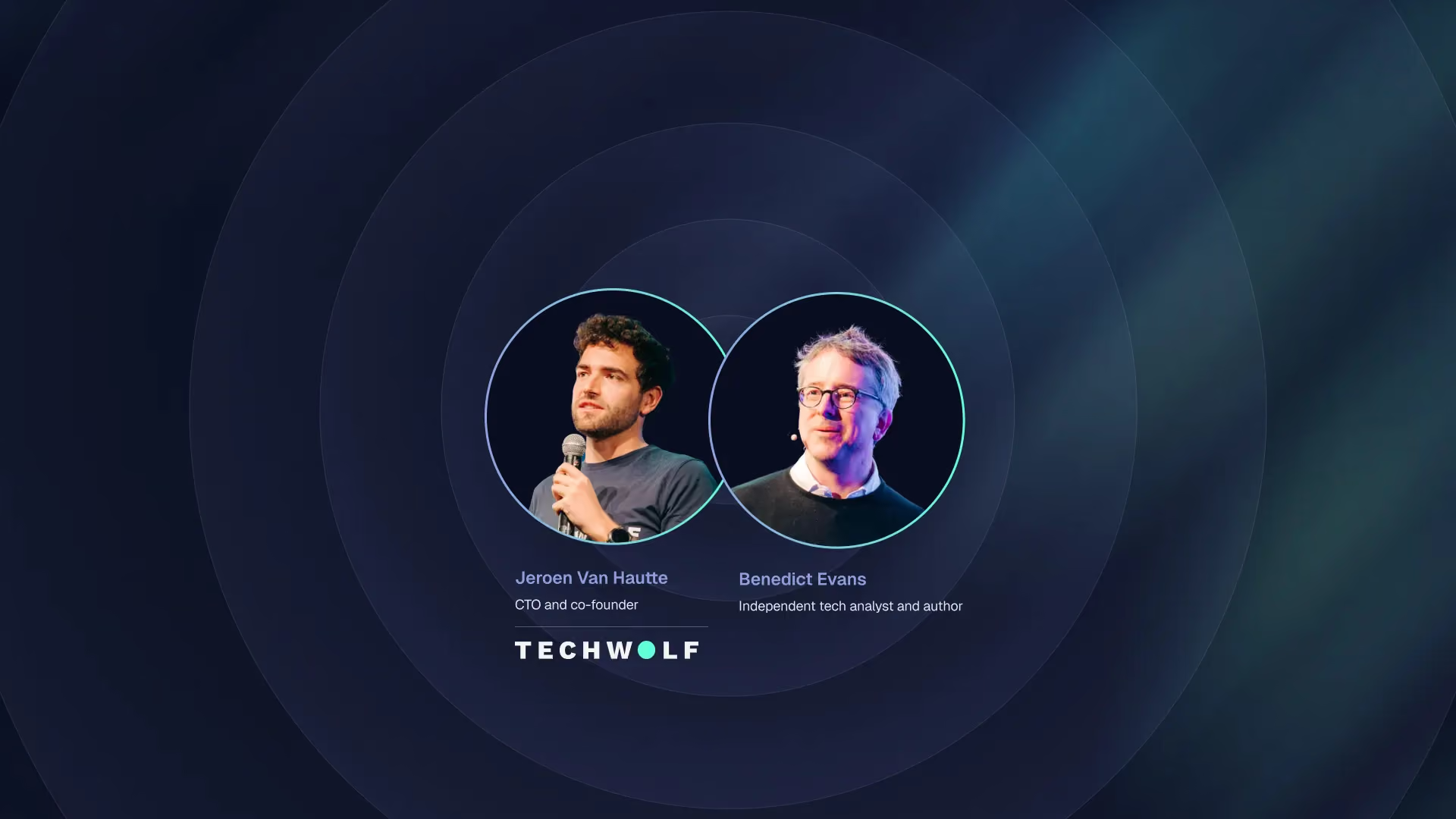
Reading the AI shift: our CTO Jeroen Van Hautte meets Benedict Evans