Pioneering a Skill-Based Future: UCB's story

January 14, 2025
3 min read
Contents

TechWolf’s COO Mikael Wornoo recently hosted a conversation with UCB’s Head of IT Talent & Company Reputation, Christophe Cabrerato, exploring how leading organisations are putting a skill-based approach in action today with three practical tips to help you get started. Christophe shared his experience of applying a skill-based approach to support the transition from a pharma to a bio-pharma company, plus his experience of working with TechWolf. Here are some of the main takeaways from the session:
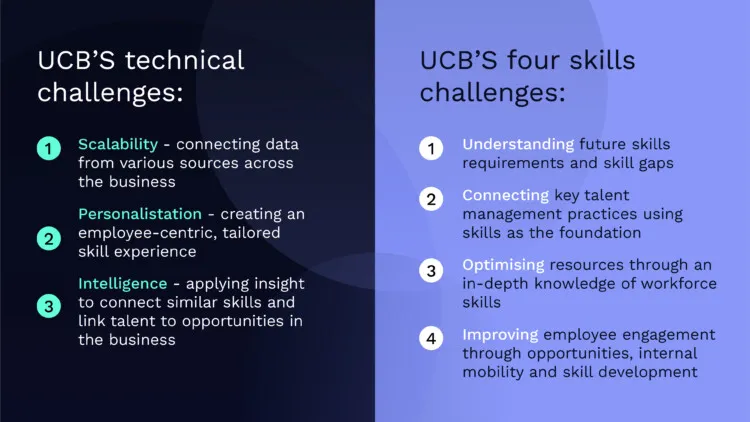
UCB BLOG VISUAL 1
Visual UCB Challenges

From this starting point, UCB were able to identify three use cases to see how a skill-based approach could improve outcomes:

  1. Strategic Capability Planning - identifying and tracking skills and moving from a top-down, internal and manual process to a top-down/bottom-up approach. This also included using market benchmark data with low manual input to create a data-backed skill gap analysis.
  2. Job Catalogue - the creation of a solid skill architecture and governance structure that was regularly updated based on external market trends.
  3. Internal Mobility - gaining a full overview of potentially suitable internal candidates for open positions and identifying what reskilling and investment was required.

Working with an initial group of around 500 employees, UCB compiled a comprehensive job catalogue, personal job descriptions, and learning and job history. TechWolf leveraged this data to:

  1. Build a skill taxonomy
  2. Map jobs to skills
  3. Map people to skills

While UCB’s journey in skill development is ongoing, they are already harnessing skill data to drive value and significant transformation across the organisation. In just a few months, they have produced valuable skill insights to bolster strategic capability planning.

Mikael concluded the conversation with actionable insights for embarking on a skill-based journey:

  1. Get going, with a goal in mind
    - Start with a trial project that is big enough to be meaningful but focused enough to be manageable
    - Be specific with a clear business problem to solve
    - Set ambitious but realistic timelines
  2. Stop obsessing over who should own skills (for now)
    - A skills project can start anywhere in the business
    - There is no clear “owner” for skills
    - Be intentional about governance across the business
  3. Focus on the value from skill data first. Integration will follow
    - Apply skill data to the business problem in practice
    - Then, set up integrations and processes to maintain it
No items found.

Blog

Relevant sources

From guides to whitepapers, we’ve got everything you need to master job-to-skill profiles.

View all
View all
Skills
Strategic Workforce Planning
Blogpost

Why skills-based workforce planning failed 92% of organisations, and what replaces it

Skills-based workforce planning failed 92% of organisations because static taxonomies, self-reported data, and snapshot approaches couldn't keep pace with AI-driven change. Work intelligence is the missing data layer that completes it.
TechWolf
Dec 16, 2025
Why skills-based workforce planning failed 92% of organisations, and what replaces it
AI
Strategic Workforce Planning
Blogpost

AI for workforce planning: why your planning tools are only as good as your skills data

60% of HR leaders plan to increase AI workforce planning investment by 2027, but most organisations can't answer a basic question: which skills do we have? Learn why skills intelligence is the missing foundation.
TechWolf
Nov 18, 2025
AI for workforce planning: why your planning tools are only as good as your skills data
Skills Intelligence
Skills
Blogpost

What is talent intelligence? (and why most companies are getting it wrong)

72% of companies are increasing investment in talent intelligence, yet most implementations stall. The problem isn't the concept. It's that talent intelligence is a decision layer built without its data foundation: skills intelligence.
TechWolf
Oct 23, 2025
What is talent intelligence? (and why most companies are getting it wrong)

Using AI while interviewing at Techwolf

At TechWolf, we see generative AI as part of the modern toolkit — and we expect candidates to treat it that way too. We love it when people use AI to take their thinking to the next level, rather than to replace it.You are welcome to use tools like ChatGPT, Claude, or others during our interview process, especially in take-home assignments or technical exercises. We encourage you to bring your full toolkit — and that includes AI — as long as it reflects your own thinking, decisions and creativity.We don’t see AI as replacing your skills. Instead, we’re interested in how you use it: to brainstorm ideas, speed up iteration, validate your thinking, or unlock new ways of approaching a challenge. Great candidates show judgment in when to rely on AI, how to adapt its output, and where to go beyond it.

What we’re looking for:

Our interviews are designed to understand how you think, solve problems, and express ideas. Using AI in a way that amplifies those things — not masks them — is encouraged.

What to avoid:

We ask that you don’t submit AI-generated work without review, or present answers that you can’t fully explain. We’re not testing the model — we’re getting to know you, your skills, and your potential. If there are cases where we don’t want you to use AI for something, we’ll tell you ahead of the interview being booked.In short: use AI as you would on the job — as a smart assistant, not a stand-in.

Example: Programming with AI

In a coding challenge, you’re welcome to use generative AI to support your workflow — just like you might in a real development environment. For instance, you might use AI to quickly generate boilerplate code, look up syntax, or get a first-pass solution that you then adapt and debug collaboratively. What we’re interested in is your ability to reason through trade-offs, communicate clearly, think about complexity and iterate effectively — not whether you memorized the syntax perfectly. If using AI helps you stay in flow and focus on higher-level problem-solving, we consider that a strength. There could be some challenges where we won’t allow you to use AI - in that case we’ll tell you in advance, and will tell you why.

Heading

Contents

Heading 1

Heading 2

Heading 3

Heading 4

Heading 5
Heading 6

Lorem ipsum dolor sit amet, consectetur adipiscing elit, sed do eiusmod tempor incididunt ut labore et dolore magna aliqua. Ut enim ad minim veniam, quis nostrud exercitation ullamco laboris nisi ut aliquip ex ea commodo consequat. Duis aute irure dolor in reprehenderit in voluptate velit esse cillum dolore eu fugiat nulla pariatur.

Block quote

Ordered list

  1. Item 1
  2. Item 2
  3. Item 3

Unordered list

  • Item A
  • Item B
  • Item C

Text link

Bold text

Emphasis

Superscript

Subscript