
Why ‘layoffs + rehiring’ is the worst answer to the AI transformation

A new mandate for CHROs in the AI era
In boardrooms across the world, the conversation has shifted. Directors are no longer asking if AI will transform their organisations, they are asking where it hits the P&L next quarter. But as pressure mounts to show returns on AI investments, most enterprises are running into a mathematical wall: they buy technology that moves at the speed of code, but try to staff it with a recruitment engine that moves at the speed of notice periods. Mikaël Wornoo, TechWolf’s founder and president: “Reskilling & redeployment will become critical to navigate a changing world of work.”
The numbers confirm the disconnect. While 92% of companies plan to increase AI investment, only 1% of leaders describe their organisations as "mature" in AI deployment (Source: McKinsey, The State of AI in 2025).
We asked our founder and president, Mikaël Wornoo, to shed his light on this evolution.
There’s other McKinsey data, from the Generative AI and the Future of Work report, that suggests that up to 30% of work hours could be automated by 2030. This creates a volatility that traditional hiring simply cannot match. If you are trying to recruit your way out of a 30% capacity shift, you have already lost.
Most enterprises are flying blind on skills and work
The root of the problem is that most organizations are operating in Skills Blindness. They attempt to plan a future-proof workforce using static legacy data of job titles and taxonomies.
As Mikael puts it: "According to the World Economic Forum, about 40% of core skills are expected to change rapidly. Since then, the speed of change has massively increased. Still, most enterprises are flying blind: they can't see the skills they have, don't know the skills they need, and don’t know what work is actually done. They’re making multi-million dollar talent decisions based on messy, incomplete, and self-reported data" .
The solution requires a fundamental shift. We must move from looking at titles to looking at the work itself, using data from where work actually happens (Jira, Salesforce, GitHub, Google Suite, etc.) to understand the granular reality of skills and tasks. Once you have this "Work and Skills Intelligence," the strategy shifts from a slow, expensive external search to a rapid internal realignment.
The new playbook for CHROs: redeployment over recruitment
“Gartner’s latest research highlights a critical evolution, too”, says Mikaël. “AI is now viewed as a viable alternative to human talent. Contrary to common belief, this doesn't have to mean mass redundancy and rehiring. No, it means massive and intentional redeployment. But that requires reliable, correct, real-time and unbiased data on the work ànd the worker - something most companies don’t have yet.”
When a global technology company faced the classic M&A challenge: overlapping roles in sales and product engineering during a major acquisition, they didn't default to the slow, painful process of layoffs and rehiring. Instead, they used work intelligence to spot precise capability overlaps.
The result? They pooled talent strategically and reallocated work based on proven capabilities, resolving in weeks what would typically take months.
This is the new playbook for CHROs: identifying where AI automated or augments tasks and, thus, frees up capacity. And immediately moving that human capacity to higher-value problems.
Mikaël Wornoo
Fix specific gaps, don't sheep-dip the workforce
As the workforce reshapes, the old model of sheep-dip training, generic courses for everyone, becomes obsolete. Mikaël: “You can argue if this kind of people development was ever effective in the first place. But in the AI era, it’s crystal clear: things need to change, as capabilities expire faster than ever.”
Gartner findings show that evolving the HR operating model to support agile, digital delivery is the single highest-value lever available to CHROs. It drives a predicted 29% impact on AI productivity gains, outperforming culture initiatives and knowledge sharing. “In other words”, says Mikaël, “the AI transformation is a people transformation, and it’s HR’s time to lead.”
One of our customers proved this when they realised customer service wasn't a monolith, but a collection of distinct roles with different bottlenecks. By shifting to precision enablement, training focused strictly on the specific task gaps in each role - they achieved 23% improvement in cycle times and 40% reduction in overall training spend. They didn't train more; they trained smarter. And doing so, they’re leading the way in navigating JET into the new world of work.
The end state: a blended workforce where humans and AI agents work together
The ultimate goal is not just to plug holes, but to design what Gartner calls the human-machine era. This means moving beyond viewing AI as a bolt-on tool and designing a blended workforce where humans and agents co-deliver work.
Ericsson is already living this reality. By mapping the skills of over 100,000 employees, they identified exactly where cloud capabilities existed and where they were missing. They then built AI-native workflows, teaching developers how to use AI for code generation on routine tasks. The overall goal was to making them faster and structurally more valuable. The result: up to 75% of employees upskilling in critical areas.
A new mandate for CHROs: build a now-next talent strategy
Visibility without execution changes nothing. “The winners of the next decade won't be the companies that hired the most people”, Mikaël concludes. “It will be the companies that have the best intelligence on the people they have ànd the work they are doing - and project that into the AI era. Understand the work ànd the worker: that is what will separate the wheat from the chaff.”
Consequently, for CHROs, there is a new mandate on the table: to develop a now-next talent strategy .
CHROs need to stop ‘running HR’, move beyond being a service center and become the architect of the workforce strategy. This requires a now-next approach: optimize current potential now (0-12 months) by redeploying the capacity AI releases, while simultaneously building the differentiated capabilities for next (1-3 years). Success won't be defined by the AI tools you buy. It will be defined by the skills of the people who use them.
Mikaël Wornoo, President at TechWolf
Download the guide
Discover the key foundations for building a lasting skill-based organization.
Blog
From guides to whitepapers, we’ve got everything you need to master job-to-skill profiles.

The friction layer (Part 2): Why the most AI-exposed function isn't the most strained

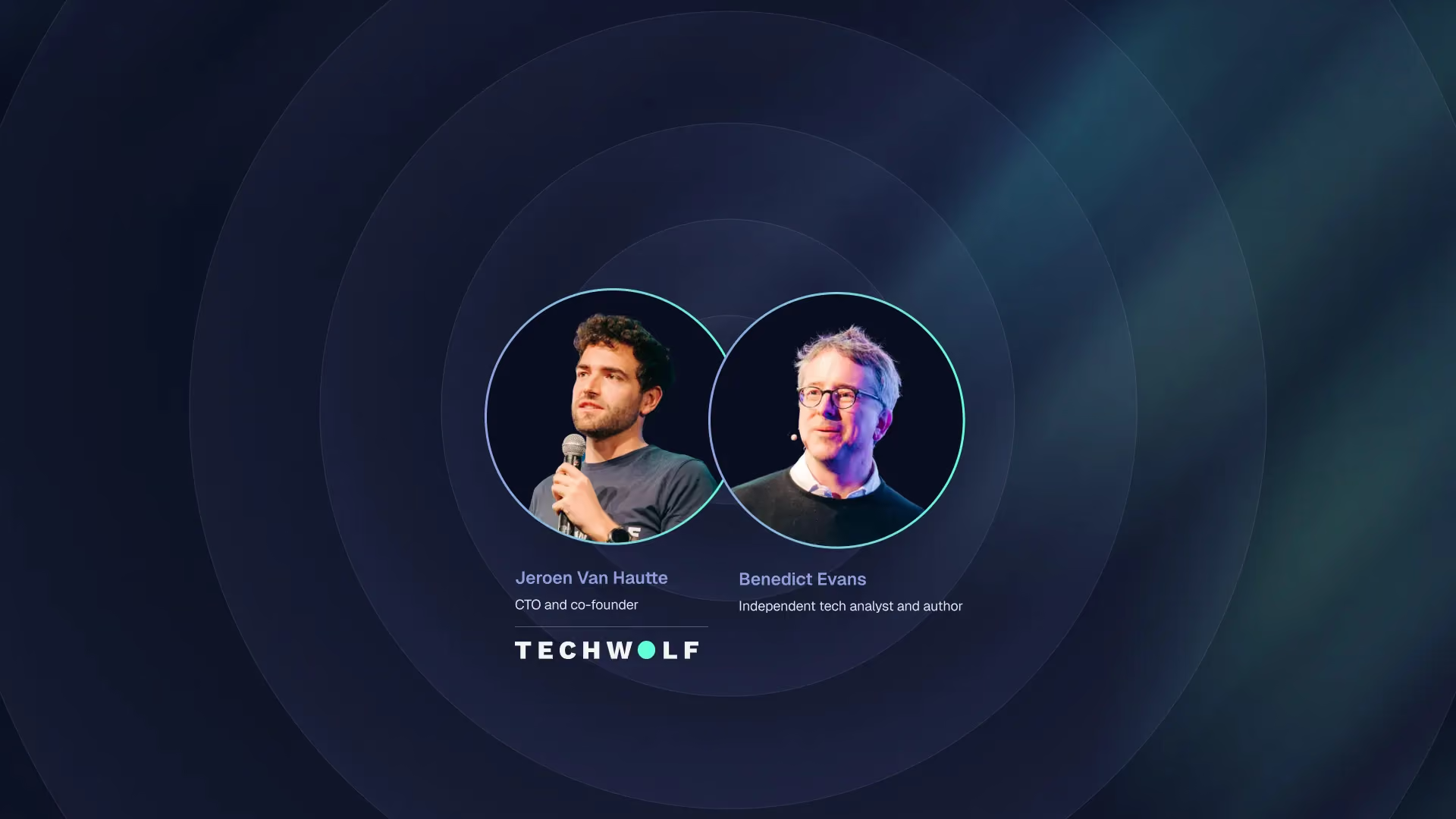
Reading the AI shift: our CTO Jeroen Van Hautte meets Benedict Evans
The friction layer: Where structural AI pressure actually lands