
Reading the AI shift: our CTO Jeroen Van Hautte meets Benedict Evans

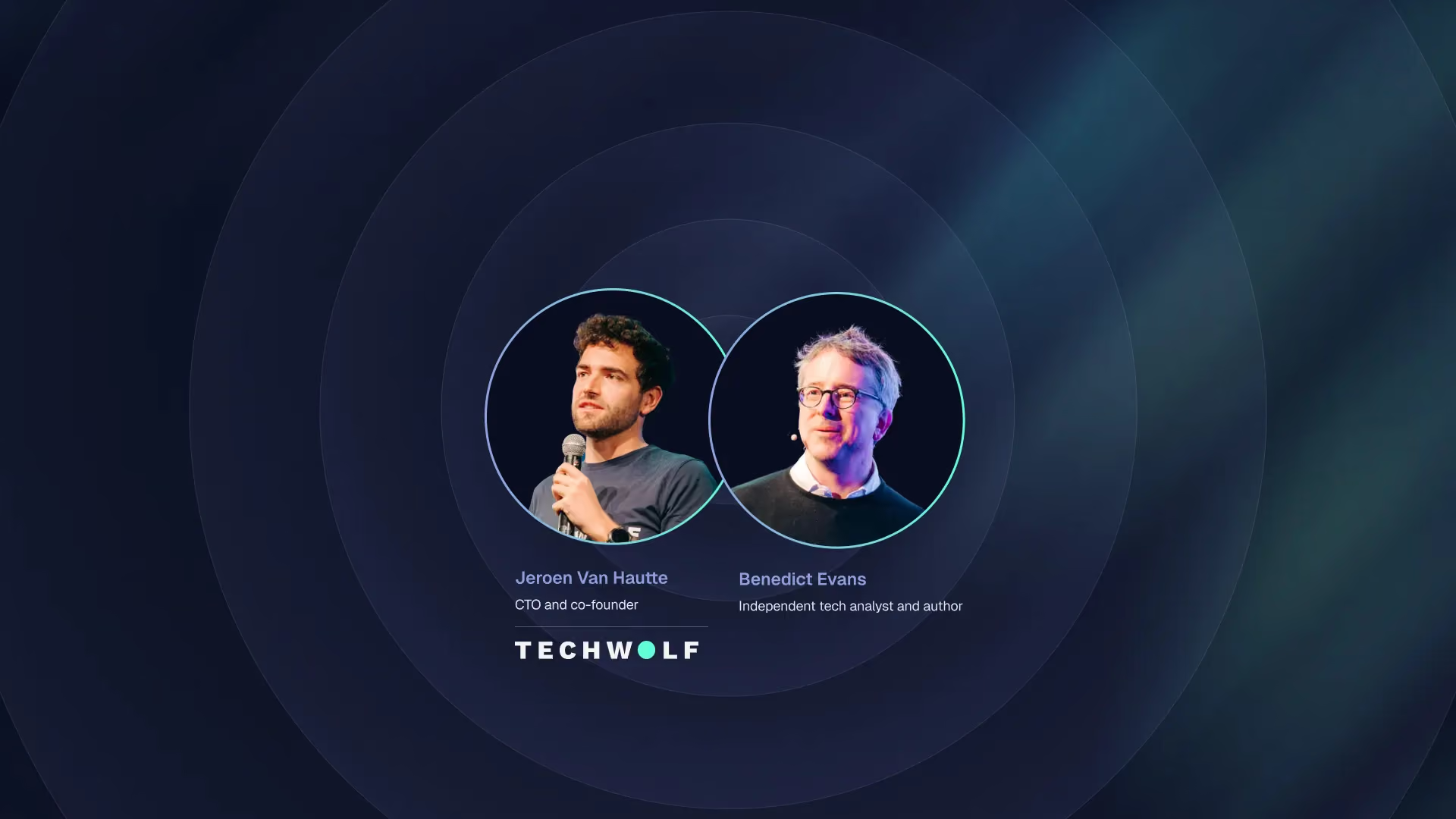
We invited independent analyst Benedict Evans to headline the main stage at AI Day 2026, our flagship event in Ghent, co-hosted with Wintercircus. Ahead of his keynote, De Tijd sat down with Benedict and our co-founder and CTO, Jeroen Van Hautte, for a joint conversation about what AI really changes for the people doing the work. Here are the highlights.
Few people read platform shifts as clearly as Benedict Evans. Across more than twenty years, including a spell as a partner at Andreessen Horowitz and through his widely read Benedict's Newsletter, he has tracked every major transition: PCs to the internet, the internet to mobile, and now AI. That is exactly why we asked him to headline our AI Day 2026 main stage.
You might have already caught Wim De Preter's interview with Benedict Evans in De Tijd. What follows is the expanded version of that conversation, with TechWolf's co-founder and CTO, Jeroen Van Hautte, joining the table. The pairing was deliberate: Benedict brings the long view of how these shifts tend to play out, while Jeroen brings the practitioner's view, building products on the frontier and helping large enterprises understand how AI is changing work and the skills their people need.
You have called AI the biggest platform shift since the iPhone, but not more than that. Why hold both ideas at once?
Benedict Evans: I try not to get preoccupied with ranking these things. Is this bigger than the internet, smaller than mobile? Those are not productive conversations. What matters is remembering how many times everything has changed before. PCs, the internet, telecommunications, electricity: all of them changed everything. Generative AI sits comfortably in that line. There is a view that it produces human-level intelligence and replaces every job, which would make it bigger than electricity. It might. But there is no convincing reason to believe that yet, so I would rather be honest about what we know and what we do not.
Jeroen Van Hautte: I agree, no one knows the exact size of this shift in the long run, but the honest answer still has to be useful. The impact of AI on work in small and big companies is significant. AI is rewriting work faster than organizations can adapt. Our clients cannot wait for the uncertainty to resolve before they act. What we can do is give them a clear picture of the work happening inside their organization today, and where AI can have an impact on it now. That is a far more practical starting point than guessing where the technology lands in five years.
AI is often called the fastest-adopted technology ever. Yet a lot of people still use it lightly, if at all.
Evans: It is very easy to try once, because there is no device to buy. In the US, 50 to 60 percent of people now say they have used AI at work. But that is like asking someone in 1997 whether they had ever been on the internet. Daily use is the better measure, and that sits closer to 10 or 15 percent. For developers, marketers and support teams the fit is obvious. For a lot of other roles it is not, and most people are not sitting in an office park redesigning their own job. They need products and tools that show them what to do with it.
Van Hautte: The tooling has genuinely improved, though, and that lowers the barrier fast. When we opened up our internal AI training a while ago, the first section was how to use version control and how to stop the tool from breaking your machine. In the version we released for AI Day, we cut all of that out. It is no longer necessary. The extreme adopters are still a small, concentrated group, and the real work now is bringing everyone else along.
So where does the value actually land? There is a lot of anxiety about whether the AI investments are durable.
Evans: Right now the models look like commodities. A handful of companies sell something broadly comparable, which points to a low-margin infrastructure business priced close to marginal cost. The cleanest comparison is telecoms. Mobile bandwidth has increased roughly 2,000 times since 2010, and while operators spend 15 to 20 percent of revenue on capacity every year, revenue and profits remain flat. Enormous value gets created on top of that infrastructure, not inside it. The interesting question is never the pipe itself. It is what becomes possible on top of it. Think of recorded music: the shift was not cheaper CDs, it was paying a flat monthly fee for all the music there is. That is a completely different product, and with AI we are right at the start of finding those.
"The interesting question is never the pipe itself. It is what becomes possible on top of it." Benedict Evans
Van Hautte: That is exactly where the opportunity to build real software comes back. If you have a robust system running and the model sits as a thin, well-engineered layer on top, you get something very different from a model that improvises everything from scratch each time. We see it in our own stack. Even something as basic as how you define revenue: if you do not engineer that definition into the system, you get a different answer every time you ask. The value is in that engineering, not in the raw model.
"The value is in the engineering, not in the raw model." Jeroen Van Hautte
Does that mean AI ends software companies, the so-called SaaSpocalypse?
Evans: There is a straw man that says everyone will build their own SAP. Almost nobody seriously believes that. Writing software does get much faster and cheaper, which has happened before with spreadsheets and every new programming tool, but the deeper question is where the model sits in the stack. Does it go at the bottom, as a feature inside the systems you already use? Or on top, as a layer you ask to look across everything at once? Both let you ask questions you could not ask before. What you cannot do is replace a deterministic system, where there is one correct number, with a probabilistic one.
Van Hautte: It is a shake-up, not an apocalypse. A year ago we had one product; today we have three, and without AI that simply would not have happened. Part of that is demand, but part is that one person can now have an outsized impact on whether a whole product line exists. Our engineers each ship around 60 to 70 percent more functionality, and that is real customer value, not just more lines of code. The companies that win are the ones treating this as a chance to build more, not just defend what they have.
"Our engineers each ship around 60 to 70 percent more functionality and that is real customer value, not just more lines of code." Jeroen Van Hautte
For enterprises transforming workforces of tens of thousands of people, what is the best strategy to navigate them when the technology itself is moving this fast?
Van Hautte: We plan for two opposite worlds at once, and we ask them to do the same. One where tokens become almost free, and one where they get ten times more expensive. Rationally you can hold both; culturally it is hard, because if you assume cost goes to zero you push everyone to use as much as possible, and if you assume it gets expensive you focus on restraint. So we put real infrastructure in place just to understand where our own usage goes. The point is not to predict the future perfectly. It is to stay close enough to what the models can do that you can move the moment the picture clarifies.
Evans: Large organizations struggle here because they are holding those two ideas at once and it can leave them paralyzed. A startup is built for sudden change; if the world shifts overnight, that is almost good news, because it shifts for everyone. Big companies do not have that luxury, which is why having a clear view of their own work matters so much. You cannot act on what you cannot see.
"You cannot act on what you cannot see." Benedict Evans
Reliability is obviously a critical factor. How dependable are AI models today?
Evans: LLMs are roughly where PCs were in the mid-90s, when applications crashed constantly and took everything else down with them. It is amazing, and it does not reliably work, and you can still wipe out your data by accident. It is always asking what the answer probably looks like, and getting from there to always being right may be a kind of Zeno's paradox, where you keep getting closer to perfection, but never quite reach it. But we do not always know when we are right either, and it is already extraordinarily useful.
Van Hautte: We call it the jagged edge of capability. Our logic says if the model can do this task or assignment, surely it can do that one too, and then suddenly, it collapses on something trivial. You have models solving decades-old math problems and then failing to count the letters in a word. That is why trust matters so much in our domain. It is easy now to create something that looks good, and hard to validate that it actually is good. So we publish our research and open up our models, so people can verify the science themselves rather than take our word for it. Building the expertise and hygiene around that edge is most of the job.
"It is easy now to create something that looks good, and hard to validate that it actually is good. That is why trust matters so much in our domain." Jeroen Van Hautte
Underneath it all, what makes AI genuinely different from the shifts you have lived through?
Evans: With the internet I spent a lot of time describing what we did not know, but you still knew the physical limits. You knew how fast computers and broadband would get. With generative AI we do not have those guardrails. We do not have a good theory of why these models work as well as they do, so we cannot draw a chart and say it crosses human capability in 17 months. The progress might accelerate, slow down, or hit a wall. It has not so far, and that openness is the opportunity.
Van Hautte: Nobody gets to wait, and we see that as energizing rather than frightening. We act on what is in front of us today while planning for both extremes of tomorrow. The job, for us and for the companies we work with, is to take the next concrete step and learn from it, instead of pretending we can see the whole road. That is how real progress gets made.
"Focus on the next step instead of trying to see the whole road immediately. That is how real progress gets made." Jeroen Van Hautte
Want the full picture? Watch Benedict Evans's and Jeroen Van Hautte's keynote sessions from AI Day 2026 here.
Blog
From guides to whitepapers, we’ve got everything you need to master job-to-skill profiles.
Reading the AI shift: our CTO Jeroen Van Hautte meets Benedict Evans
McKinsey x TechWolf on AI, agents, and the next decade of work

From people analytics to workforce intelligence: Why banking needs a "data lake" for skills