
When code gets cheap, judgment gets expensive

Earlier this year, one of our junior engineers proactively built a prototype for an idea he had: a tool that connected to the large AI providers (i.e. Claude, Gemini, Cursor) processed their usage logs, visualised AI adoption across a team, and proposed tailored recommendations on which AI tools & techniques fit each team. He went from idea to a working dashboard on real data, demo video included, in less than a week. The internal reaction was instant hype: a wall of fire emojis, and our commercial team asking that same afternoon whether they could show it to customers.
And then we paused it.
Not because it did not work - because critical judgment said "not yet". Our customers were not ready for it, other features had to land first, the infrastructure to connect to these AI systems was not there yet, and parts of the prototype sat outside our product strategy.
The easy call was to ride the hype… but that road would have meant weeks of hardening the feature while adoption would have likely lagged behind the excitement. Worse still: it meant shipping a visualisation layer we would not want to own long term… So even if adoption did take off, a painful deprecation would be waiting at the end of it.
The hard call was to pause the work and sequence it for later. It was also the right one.
Recently, we have seen this story replay across our teams: with the rise of AI, the building has become radically cheap. Everything around the building, however, has grown more valuable: validating the problem with customers, fitting the solution into the strategy, calling the timing.
AI: a 10x upside, or a 10x downside
As the story shows, AI has collapsed the cost of building software but the change cuts both ways, which is why we think of AI as a multiplier on your decisions.
Good decisions can now carry a 10x upside. You reach the customer quicker. You ship more product with the same team. You explore ideas that would never have been feasible or would have required a quarter of roadmap before.
Bad decisions may carry a 10x downside hazard. You create legacy at record speed. You end up maintaining systems that were never designed to scale. You onboard customers onto products you later have to kill.
The multiplier does not care which way it multiplies.
So the bottleneck moved. In many scenarios, the hard question is no longer "can we build it?" but "should we build it?". To this end you need to dig deep on what problem actually matters, which assumption to test before committing, and when to pause the exciting thing. That judgment is worth the most when it sits as close as possible to both the customer and the code.
That is the bet behind a role we are doubling down on at TechWolf: the Product Engineer.
Meet the Product Engineer
A Product Engineer owns a track from discovery to adoption. They talk to customers directly and find the urgent problem behind the request. They decide what to build, within the strategy our product team sets. They build it themselves, across the whole stack, with AI as their force multiplier. They ship iteratively, and then they watch what happens: usage, adoption, impact. What they learn feeds the next discovery.
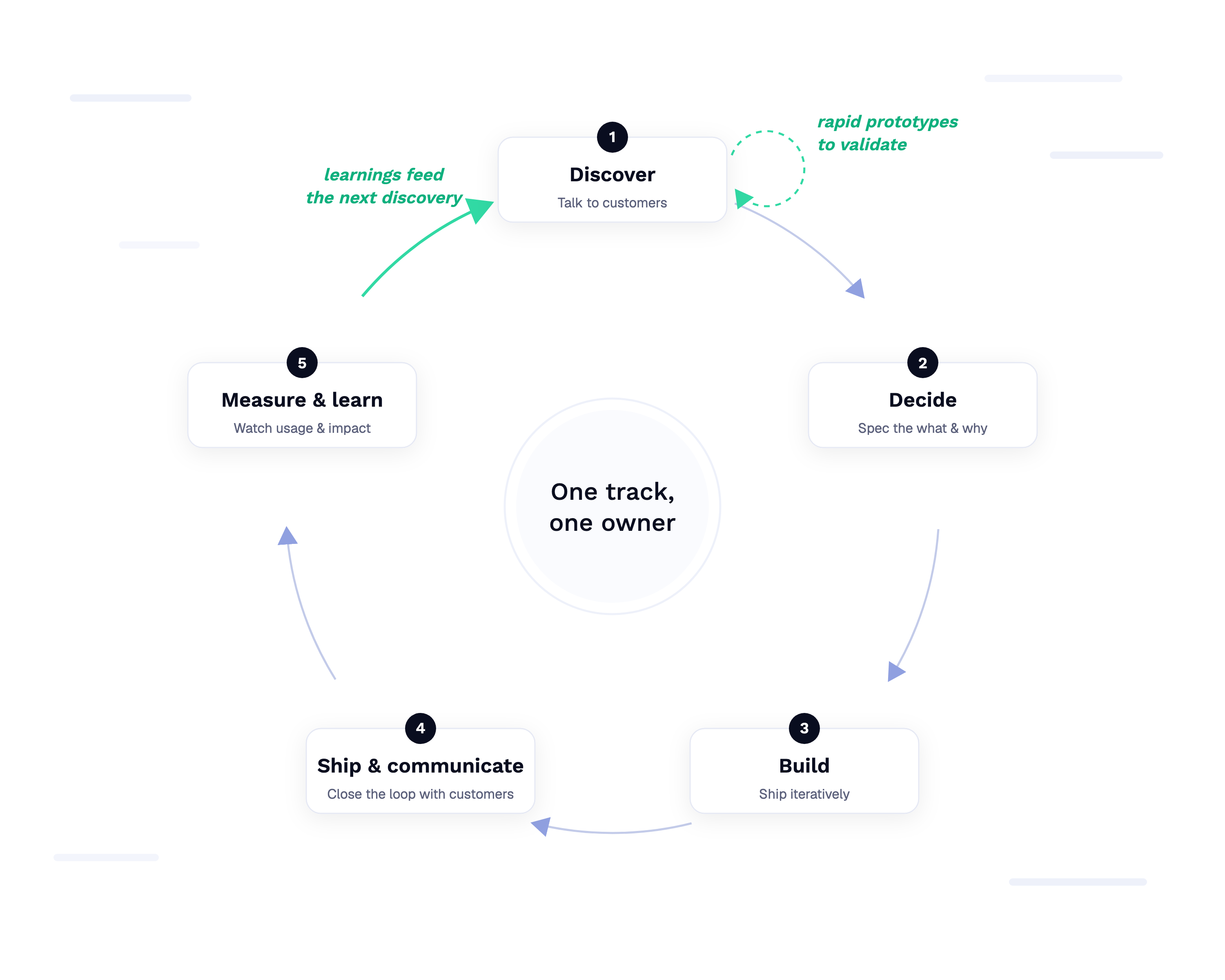
However, they do not run the loop alone: most tracks pair them with one or two Software Engineers building alongside, each with their own focus:
- a Software Engineer is predominantly accountable for building the thing right,
- a Product Engineer is predominantly accountable for building the right thing.
Why we are doubling down
We did not create this role because it was emerging in the market, but rather because we saw a pattern naturally emerge within the company: several engineers started to own the whole loop, and reaped several benefits while doing it:
Improved speed - by collapsing the oldest loop in product development
For a long time, shipping the right thing required two heads. A product manager figured out which problems were worth solving; an engineer knew what was technically possible. Between them ran an endless back-and-forth - ideas corrected for feasibility, estimates ballooning, requirements bouncing between meetings. Nobody was bad at their job: the knowledge simply lived in two different heads, and every handover between them cost time and information.
A Product Engineer collapses that loop into one head. Technical feasibility is in the room during every customer conversation, and customer reality is in the room during every technical decision. Prototyping becomes the conversation: instead of debating what might work, they build it and find out. The back-and-forth that used to take days or weeks happens in one afternoon, often with the customer watching.
.png)
Back to our original story: one week from idea to working dashboard was only possible because the idea and the feasibility judgment lived in the same head. A traditional product-and-engineering pairing would have needed far longer - long enough that the idea might never have been picked up at all.
Increased ownership - all the way to adoption
When one person owns the whole loop, there is nowhere for responsibility to diffuse. Our Product Engineers' definition of done is not a validated prototype, and not even the release itself: it is a release that customers actually use. That changes behaviour in the best way - you validate harder before building, you ship smaller and earlier, and you stay with your work after launch, because the outcome has your name on it.
Back to our original story: the hype was real and production was within reach - but the engineer weighed customer readiness against strategy fit, and paused his own work. Ownership of the outcome includes the call not to ship.
And innovation, as the bonus
The best product ideas appear where knowledge of what is technically possible meets an unfiltered view of the customer's problem. Put both in one person and you get solutions that neither a coordinating product manager nor a shielded engineer would have found. We did not design the role for this - but it keeps happening.
Back to our original story: the prototype only existed because one engineer knew what the provider APIs could do, all whilst having enough customer context to apply it to a problem worth solving.
So, should everyone become a Product Engineer?
No, even if the LinkedInfluencers might try to convince you otherwise.
A Product Engineer rarely ships alone. On most tracks they work alongside Software Engineers who own scalability, cost, performance, and security: the craft that lets a product survive its own success. A prototype that wows a demo room is not yet a system that serves enterprise customers. Closing that gap is a craft of its own, and Software Engineers practice it inside the track from day one - not as the clean-up crew afterwards. One role is accountable for building the right thing, the other for building it right, and neither works without the other.
So no, the Product Engineer is not the holy grail - not on its own. It is one role in an engineering organisation deliberately built out of complementary roles: Product Managers who set strategy and priorities across tracks, Software Engineers who make shipping safe at scale. And it is genuinely not for everyone: many excellent engineers prefer depth over this particular breadth - and that is fine, because both are equally critical to the company.
But what if you want to?
If any of this sounds like how you work, or how you want to work, then have a look at our Product Engineer vacancy here.
Blog
From guides to whitepapers, we’ve got everything you need to master job-to-skill profiles.
When code gets cheap, judgment gets expensive
Platform series: rebuilding observability so any engineer can debug a failing request

Real-time analytics, 1000× faster: our journey from Postgres to ClickHouse