The CHRO's field guide to workforce transformation
A playbook for workforce transformation
Six stories from the real world: how leading enterprises redesign work for the AI era.
Prefer to read it later? Download the PDFFor the first time, a business problem and an HR problem are essentially the same. The CEO says: 'How do I navigate the AI revolution?' The CHRO says: 'How do I reskill 10,000 people, redesign roles and work, and future-proof our workforce?' They both agree this is a priority. The momentum for HR to create true business impact has never been bigger.

Executive summary
01The AI transformation is a people transformation.
The companies winning the next era of work aren't the ones with the biggest AI budgets, they're the ones who understand their workforce with the same rigor as their tech stack.
02AI is rewriting work faster than enterprises can adapt.
The real story is work and role redesign, not replacement. But most CHROs are watching it happen without the right data on jobs, tasks, and skills.
0363% of work stays human (TechWolf, Work Intelligence Index)
AI doesn't replace your workforce, it reshapes the work your workforce does. Only 37% truly shifts. Within that number, augmentation beats automation 2-to-1. If you can't see that shift at the task level, you're a passenger, not a pilot.
04Enterprises are flying blind.
74% can't keep pace with shifting skill demands (Bersin). Most enterprises have no real visibility on jobs, tasks and skills data. Making workforce data actionable remains a big issue. Processes are manual and slow, and data is unreliable, incomplete and biased.
05The talent equation has flipped.
External hires cost ~18% more annually, are 61% more likely to be terminated, and take roughly two years to reach an internal hire's productivity (Deloitte, 2024). And everyone's hiring for AI talent now. For most skill gaps in 2026, upskilling or redeploying your existing workforce is the fastest and cheapest answer.
06Skills data alone won't cut it anymore.
You need three lenses: Skills (what your people can do), Work (how AI reshapes each role), Market (what the market and competitors are doing). Each alone solves a piece of the puzzle. Together they're the data layer the AI era runs on.
07Six use cases earn the priority.
AI transformation and role redesign are the most pressing ones. Internal mobility, workforce planning, L&D effectiveness, and skills-based hiring are close followers. The right starting point for you is the one tied to the business pain your CEO is already losing sleep over.
08It's the CHRO's time to lead the transformation.
The driver's seat is open, but it won't stay open. 66% of C-suite execs say operating models must change for AI, and 78% of CHROs themselves say workflows and roles must change for AI investments to deliver value (Gartner, 2025). Those walking in with task-level data are shaping the strategy.
09Your data is already good enough to start.
HSBC mapped 250,000 employees in five months, Workday mapped 15,000 in three. AI-powered inference runs on the data already sitting in your HRIS, ATS, and LMS, so 'we're not ready' isn't a reason to wait.
10Start small enough to manage, big enough to matter.
Pick one use case tied to a number the CFO already tracks, prove value in business metrics not HR metrics, then compound across the stack.
In every era, work shifts first and org charts catch up later. The difference now is that the shift is happening in months, not decades.

Chapters
Three forces are reshaping the workforce
Skills intelligence, work intelligence and market intelligence.
Connecting three intelligence layers to unlock new value.
Stories from the real world: what are other enterprises doing?
Where to start: small enough to manage, big enough to matter.
Here's a pragmatic framework.
The AI transformation is a people transformation.
Closing note from our President & Co-Founder Mikaël Wornoo.
Three forces are reshaping the workforce.
Three forces are reshaping the workforce
Looking around in enterprises across the world, we see three strong forces reshaping the workforce. The tough part for HR leaders is that they're happening simultaneously, at a pace that overwhelms traditional approaches. In this transformation, reliable data on your workforce has become instrumental. Skills, work, and market intelligence are quickly becoming the most urgent investment for forward-looking enterprises.
You cannot lead
what you cannot see
AI is changing work faster than most workforce plans can track.
McKinsey estimates that 57% of U.S. work hours could be automated by today's technology (Agents, Robots, and Us, November 2025). And PwC finds that industries with high AI exposure already show 4x greater productivity growth than those without (PwC 2025 Global AI Jobs Barometer).
These headlines miss the nuance, though: less than 1% of announced layoffs in the first half of 2025 are attributable to AI productivity gains (Gartner, 2025). One percent.
57% of U.S. work hours could be automated by today's technology.
Industries with high AI exposure already show 4x greater productivity growth.
Less than 1% of announced layoffs in H1 2025 are attributable to AI productivity gains.
The fastest and cheapest path to talent runs through your existing workforce
The second force is structural: finding talent externally is expensive, slow, and unreliable.
And everyone's hiring for AI talent right now.
The Skills Gap
74% of organizations are not keeping up with their demand for new skills.
(The Josh Bersin Company, 2024–2026)
The Cost Benefit
Developing internal talent is materially cheaper than hiring externally when factoring in recruitment fees, ramp time, and attrition risk.
(Deloitte, 2024)
The Retention Bonus
Employees at organizations with high internal mobility stay nearly twice as long: 5.4 years vs. 2.9 years.
(LinkedIn Workplace Learning Report, 2022)
for most skill gaps, the fastest and cheapest path runs through your existing workforce, if you have the intelligence to see it.
HR's seat at the table is open,
but not for long
The third force is organizational.
of C-suite executives say functional operating models must change in response to AI. The transformation conversation is happening at the highest level.
(Gartner, 2025)
of CHROs themselves say workflows and roles must change for those investments to pay off (Gartner, December 2025), which means the redesign agenda lands squarely on HR's desk.
(Gartner, December 2025)
The CHRO needs to become the AI transformation lead. The momentum for HR to create true business impact has never been bigger, and the data needed to lead that transformation does not yet exist in any single system.
If you can walk into the boardroom with task-level data, a skills gap analysis grounded in actual work, and market benchmarks backed by real economics, then you're delivering true business value and leading the AI transformation. But this requires a new kind of data infrastructure, one that goes beyond traditional HR metrics.
Skills intelligence, work intelligence and market intelligence.
Connecting three intelligence layers to unlock new value.
Most vendors are racing to build a smarter app on top of the same broken data. But there's another way: building the data layer underneath.
A layer with three components: each answering a distinct question, together forming a single operating picture that comes to life inside the systems and agents your teams already use.
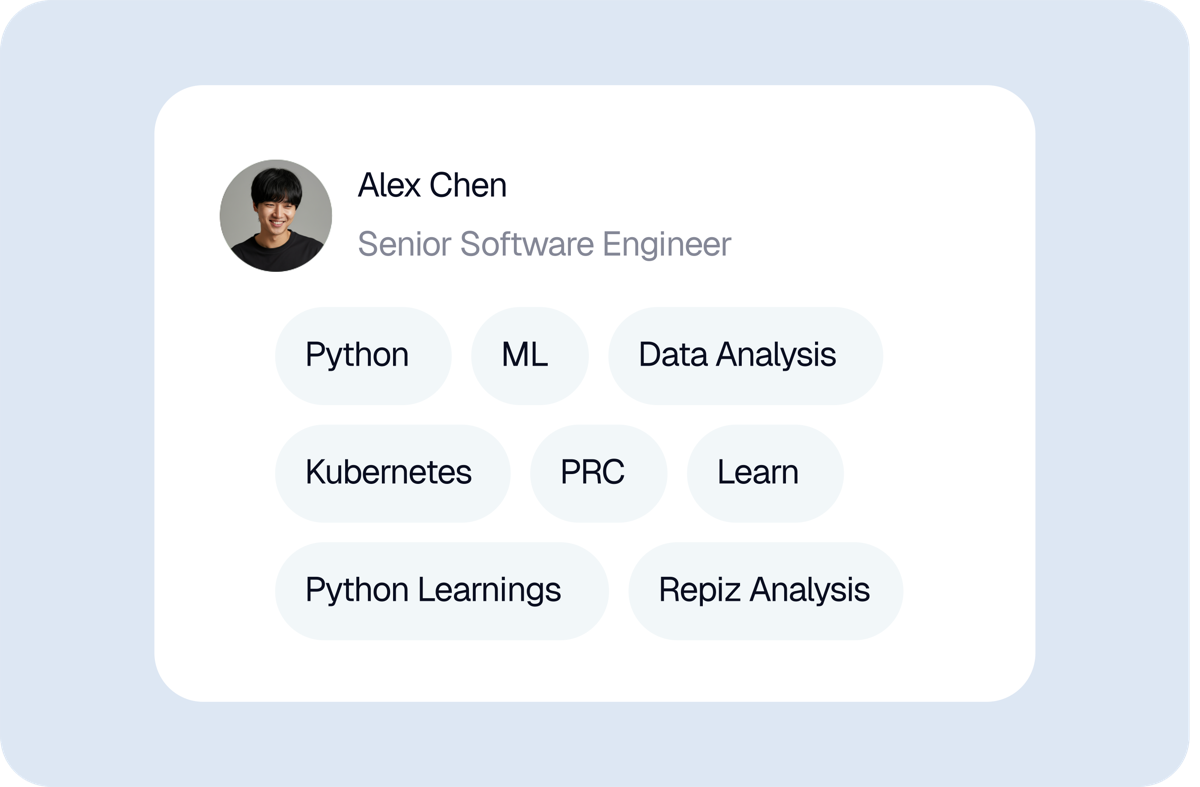
Skills intelligence
Looks inward and answers: what can our people do today, and what will we need them to do tomorrow? AI infers skills from the data you already have, not from annual self-assessments or manager guesswork, and maintains a living, continuously updated view of your workforce capabilities.
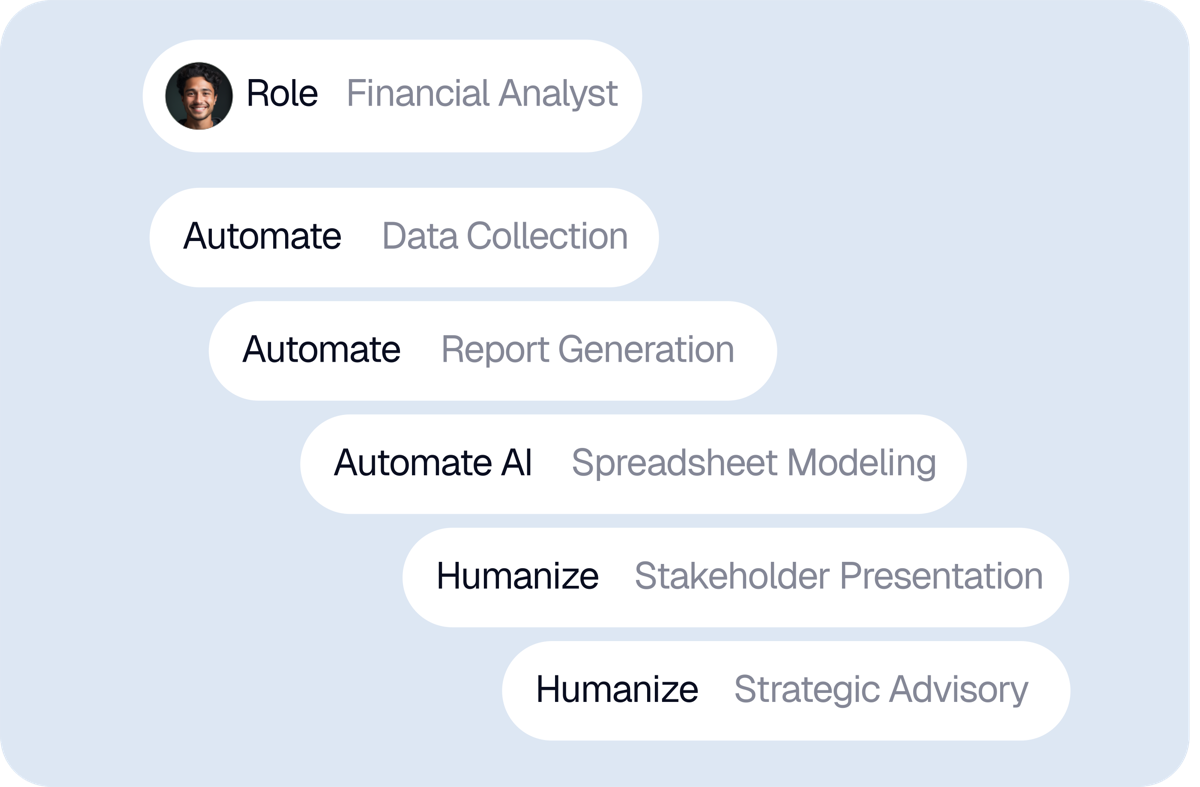
Work intelligence
Looks forward and answers: what tasks actually happen inside our roles, and how is AI impacting each one? By decomposing work into its constituent tasks and scoring each task for AI impact, Work Intelligence tells you where to automate, where to augment, and where to protect irreplaceable human judgment.
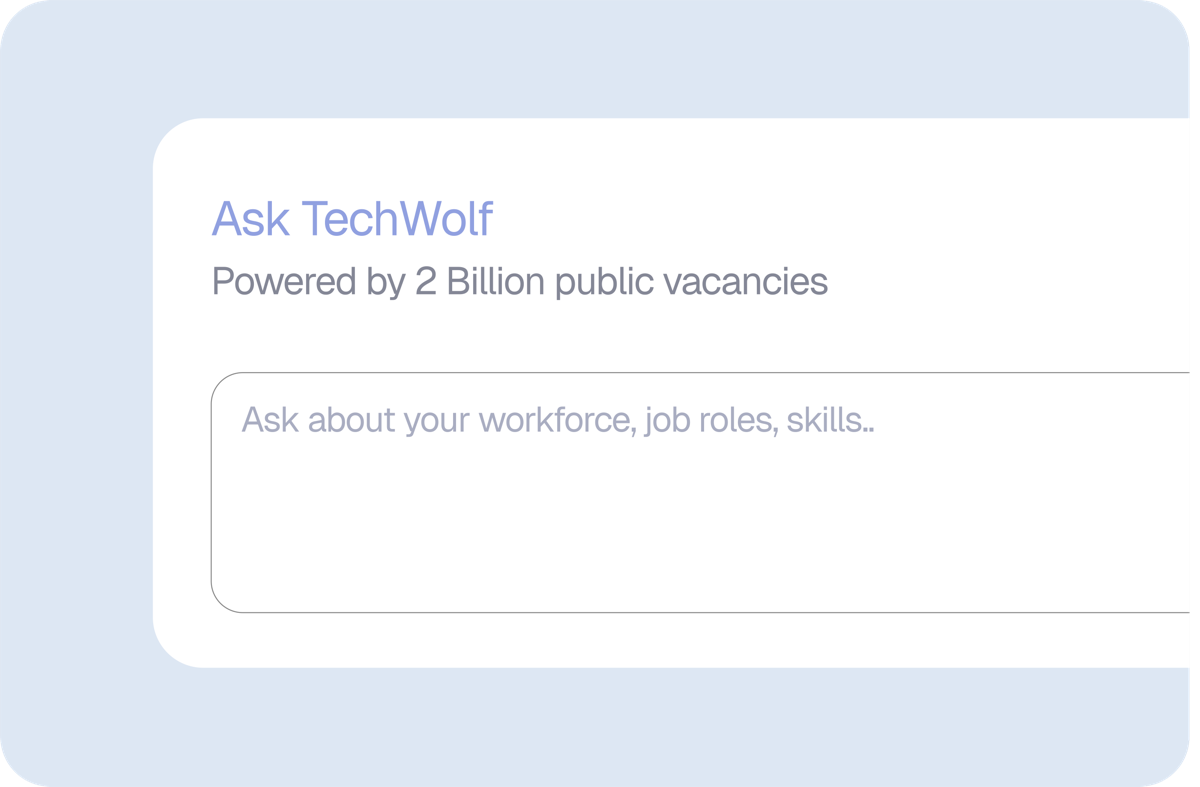
Market intelligence
Looks outward and answers: where is the labour market heading, and what does that mean for our strategy? Drawing on 2B+ job postings across eight years, Market Intelligence shows which skills competitors are hiring for, where wage premiums are shifting, and whether it is cheaper to build internally or buy externally.
Skills Intelligence without Work Intelligence describes capabilities disconnected from future demand. Work Intelligence without Market Intelligence optimises for a labour market that no longer exists. Market Intelligence without Skills Intelligence benchmarks against gaps you have not mapped. The organizations getting workforce transformation right are the ones connecting all three.
Why workforce transformation initiatives stall
Across hundreds of enterprise conversations, we see the same pattern. organizations invest in skills taxonomies without understanding the work those skills are supposed to support. And almost nobody connects to what's happening in the external market.
The data exists,
but nobody connects it
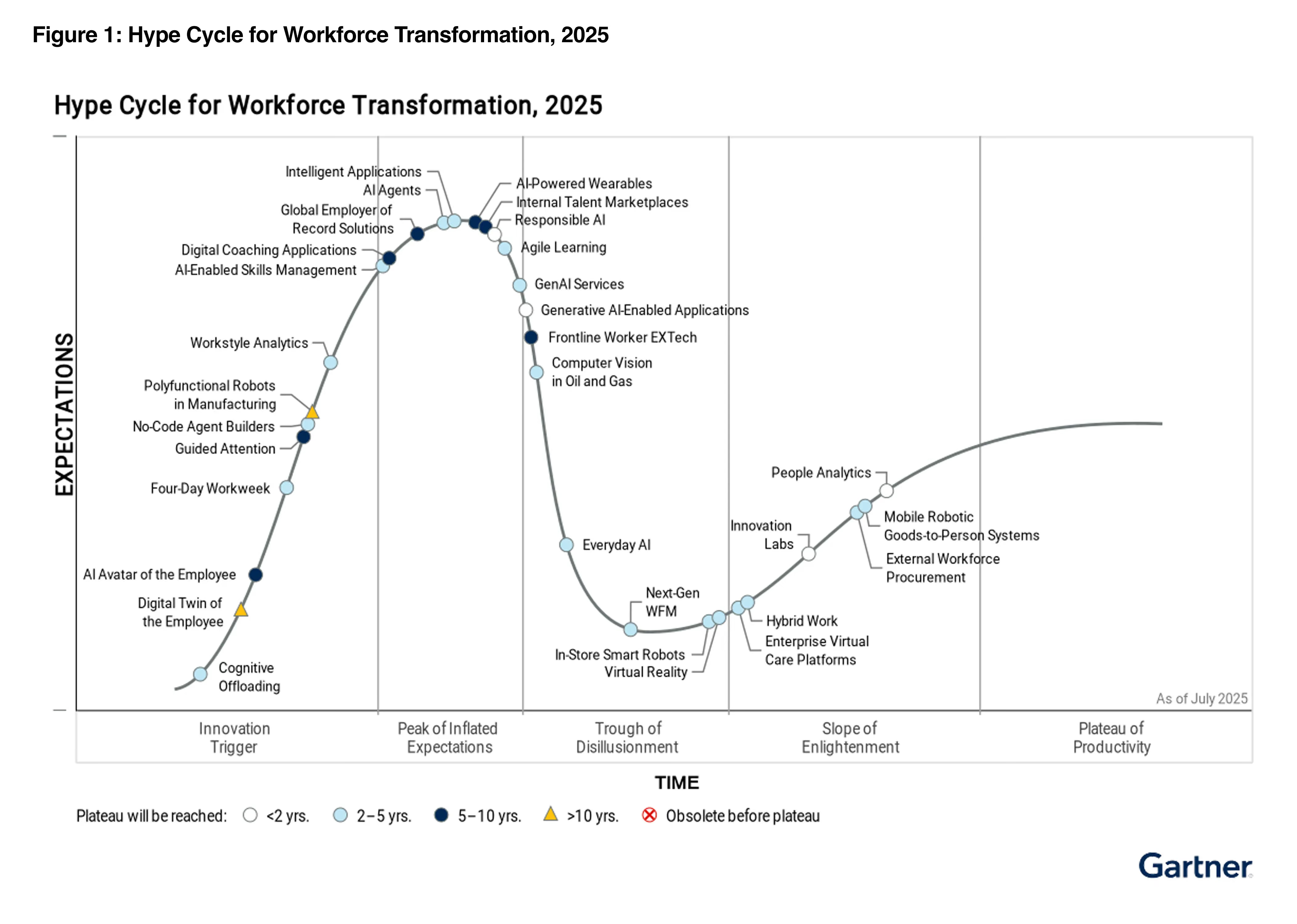
Josh Bersin calls the current moment a "trough of the hype cycle" for skills-based organizations.
The initial enthusiasm has met the friction of implementation: many enterprises built skills taxonomies, invested in skills tech, launched pilot programs, but then stalled. The pattern is consistent: skills data sits in one system, job architecture lives
in another, external market data arrives quarterly in a PDF that nobody reads. And Work Intelligence, the task-level view of what people actually do, does not exist at all. Without connection between these data sets, every layer underperforms.
What happens when you connect them
The enterprises that push through the trough share a common approach: they do not treat skills intelligence, work intelligence, and market intelligence as separate workstreams.
They treat them as one integrated data layer.
The aggregate outcomes tell the story.
higher internal hire rate when skills-to-work matching is in place (TechWolf customer benchmarks, 2025)
Nearly 2x longer tenure at organizations with high internal mobility, 5.4 years vs 2.9 years (LinkedIn)
faster time-to-hire when skills data connects to actual task requirements (Workday)
high-performing internal candidates sourced for a new forward-deployed engineering role, out of a pool of 30,000. Based on skills & work intelligence, in less than a month (ServiceNow)
These are all measured outcomes from organizations that built the intelligence infrastructure.
Where the
true value lies
The stall happens when organizations invest in one intelligence layer and expect it to carry the full weight. The breakthrough happens when all three layers inform a single decision.
A skills taxonomy that does not connect to the tasks AI is reshaping cannot guide reskilling investment. A work intelligence analysis that ignores external market data cannot inform build-versus-buy decisions.
A market intelligence feed that does not map to internal skill gaps cannot prioritise action.
The connection is where the true value lies.
Stories from the real world: what are other enterprises doing?
As a CHRO or talent leader, you can tackle many use cases to navigate the AI transformation. Below we're sharing 6 topics that have come up most often in conversations with enterprise leaders. Each with examples from the real world. In the current business reality, navigating AI transformation and role redesign are the most pressing issues.
 Redesigning roles at the speed of AI
 Navigating AI transformation
 Unlocking internal mobility
 Strategic workforce planning that actually works
 Proving L&D actually closes skill gaps
 Skills-based hiring that is more than a buzzword
Redesigning roles at the speed of AI
What's the issue?
There's not a lot of CHROs who can answer this with confidence.
PwC's 2026 CHRO architectural blueprint, with similar work coming from McKinsey, Mercer, and Deloitte, all converge on the same message: role redesign has become the defining HR priority of the AI era.
Role redesign is the HR-centric work of analysing how each role in the organization optimally changes based on internal and external triggers (such as the AI transformation) and taking into account organizational context.
It's about classifying tasks as AI-only, Human-plus-AI, or Human-only, refreshing job descriptions, and updating job architecture. It is the CHRO's lane within the broader work redesign agenda that spans operations, transformation, and the C-suite.
The cost of standing still: role redesign as key HR priority
AI is reshaping roles faster than any periodic refresh can track
but the foundation underneath, the job catalog, the role definitions, the task profiles, is still being updated on a two- to three-year cycle that relies on slow and expensive consulting projects.
Roles need to be redesigned continuously, in response to specific business triggers: a new AI agent entering the Sales team, two engineering roles converging, a clinical function evolving away from manual review.
The cost of standing still is no longer theoretical.
Productivity Loss
Gallup puts the global productivity loss from disengagement at roughly $10 trillion, with outdated role definitions a key driver.
(State of the Global Workplace, 2026).
Burnout Costs
Workplace burnout costs U.S. employers up to $21,000 per executive and $10,800 per manager annually.
(American Journal of Preventive Medicine, 2025).
Attrition & Stagnation
Attrition among high performers is now rising across 100% of industries, promotions are down in 10 of 11 industries, and internal hiring has fallen 8%.
(Workday Global Workforce Report, September 2025).
Skills, Work and Market intelligence
Role redesign is the use case where
Work Intelligence plays an invaluable role.
Skills intelligence
alone tells you who can do what, but cannot tell you which roles need to change in the first place.
Work intelligence
decomposes each role into its constituent tasks, scores each task for AI impact (AI-only, Human-plus-AI, or Human-only). It surfaces where roles have drifted far enough from current work to warrant redesign.
Market intelligence
layers on the external context: what competitors are doing with similar roles, where wage premiums on AI-adjacent skills are climbing, and whether the redesigned profile exists in the external market at all.
a live signal of which roles need to change, scenario-level analysis of what each one should look like, and the business case the CHRO can take to the C-suite.
Stories from
the real world

ServiceNow: building a new AI-native role from the inside.
Challenge
ServiceNow is rewiring its 30,000-person organization around an AI-native go-to-market motion, and that shift is forcing role-level redesign across key parts of the business. The role did not exist in the catalog before AI reshaped what customer engagements demand.
Approach
As Nur Duygun, who leads ServiceNow's Skills Centre of Excellence and Skills Intelligence, has publicly described, the work is not a once-every-five-years job-architecture refresh; it is a focused, role-specific redesign triggered by an AI-driven shift in the underlying task profile. Designing it required mapping the task reality of customer-facing delivery and building the role profile around the capability combination AI-native delivery actually needs. ServiceNow uses Work Intelligence to read the role's task reality, identify where AI has shifted that reality far enough to warrant a redesign, and then refresh the role profile.
Outcome
That role is the Forward Deployed Engineer (FDE). VP of Workforce Skills and Talent Readiness Josh Newman describes the FDE as a full-stack engineer who is also an expert in client-facing skills and “absolutely loves the green space,” sitting with a customer to co-build solutions to unanswered problems in real time. Who can step into the redesigned roles is a separate question, and the way ServiceNow approached it is covered in section 3.
How data flows back to your systems and agents
Role redesign is not process automation. TechWolf is the data layer that informs the redesign decision: which tasks are changing, where AI augments and where it does not, which roles to merge, split, deprecate, or create. The redesigned role record flows into the HCM that remains your source of truth, and customers execute the change with their own teams and existing partners. The CHRO leads role redesign; broader work redesign across processes and teams remains the agenda of operations, transformation, and the C-suite, with TechWolf providing the role-level data both sides need to make the call.
Navigating AI transformation
The question
on the table
Every CEO has the same question on the table right now:
"Are we ready for AI?"
Most HR leaders answer with sentiment, engagement scores, or high-level headcount plans. The organizations pulling ahead answer with task-level data: which roles will AI change, which tasks can be automated, and do our people have the skills to adapt?
of HR leaders plan to use some form of agentic AI by mid-2026 (Gartner)
yet only 6% are making progress on designing human-AI interactions (Deloitte).
The gap between "we need to act" and "we know how to act" is enormous, and it starts with visibility.
Start with what the work actually looks like
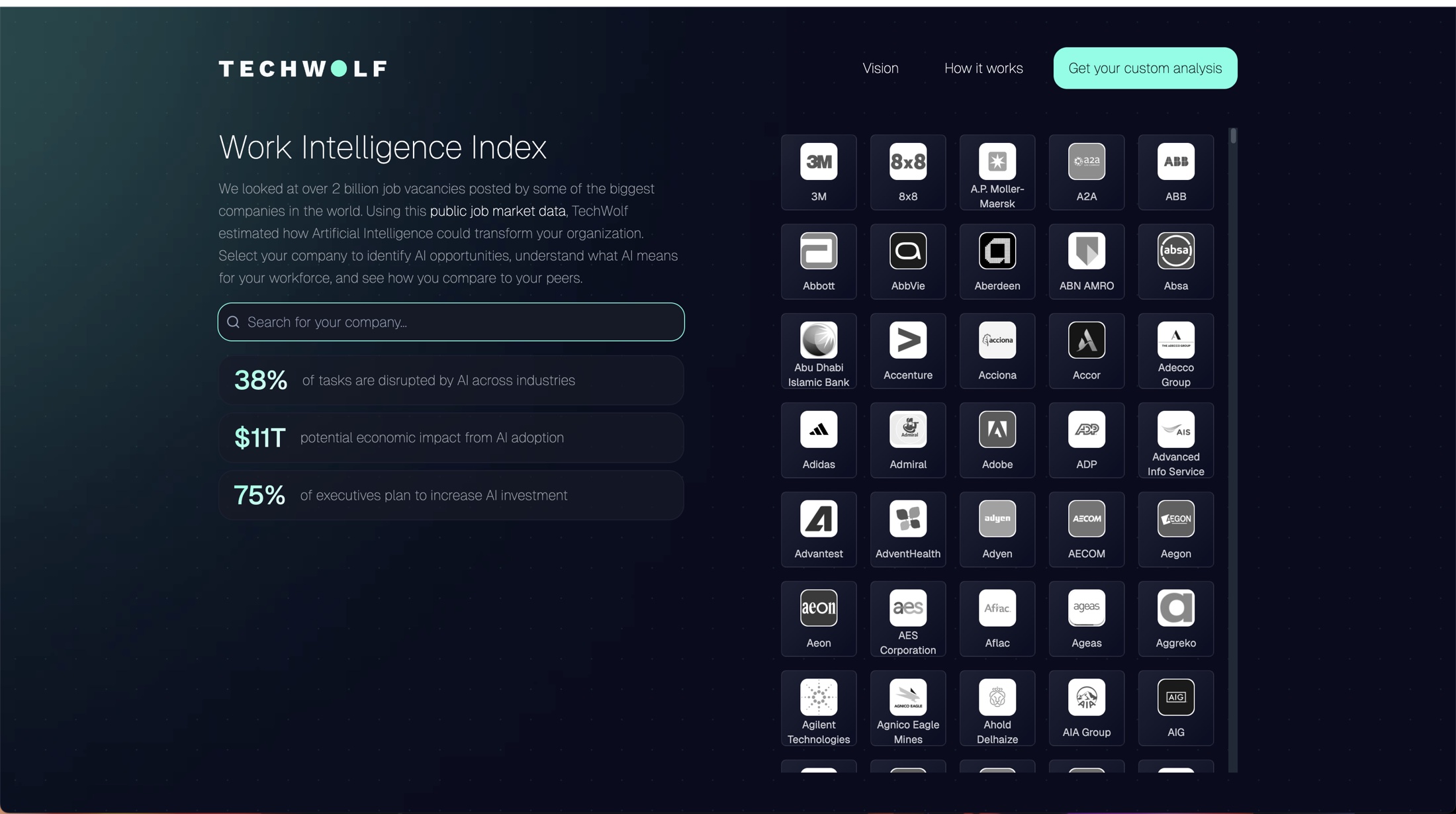
The TechWolf Work Intelligence Index provides a clear baseline:
63% of tasks remain human-led, about 37% are delegable to AI, and of that delegable share, augmentation outpaces full automation roughly 2-to-1.
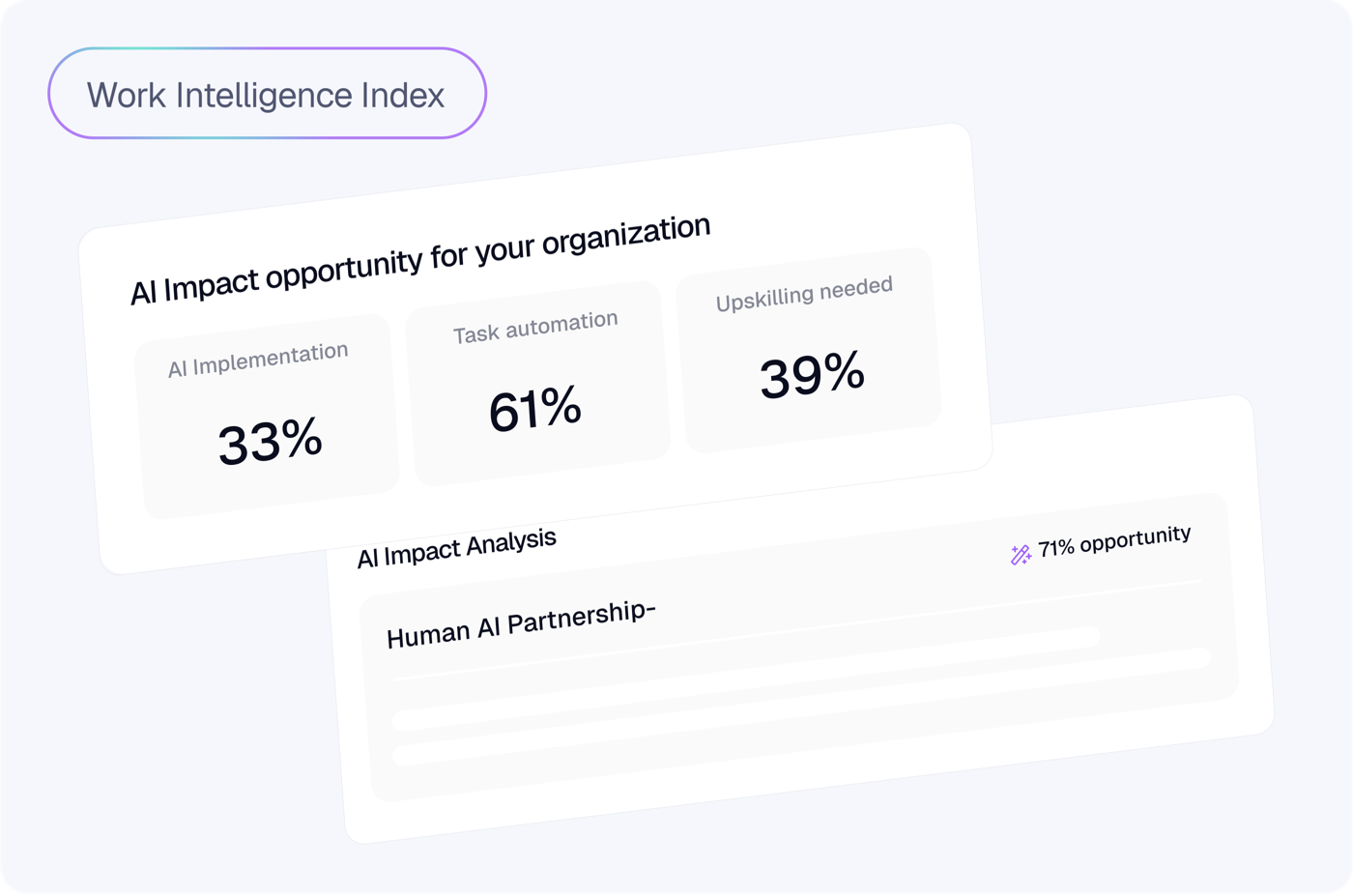
AI exposure varies enormously by role, by function, and by task, so a blanket strategy misallocates investment. The only way to get precise is to look at the three intelligence layers together.
The intelligence lens:
three layers
Looks inwardSkills intelligence
reveals who in the organization already holds adjacent capabilities, the people closest to thriving in redesigned roles. Not everyone needs retraining from scratch. Many employees are one or two skills away from the augmented version of their current role.
Looks forwardWork intelligence
decomposes every role into its tasks and scores each for automation potential, augmentation potential, and human essentiality, separating precision from guesswork.
Looks outwardMarket intelligence
shows which skills competitors are hiring for and where wage premiums are shifting. When AI-skilled workers already command a 56% wage premium, up from 25% the year before (PwC 2025 Global AI Jobs Barometer), knowing what the external market is doing changes your build-versus-buy calculus entirely.
Each layer answers a different question, and together they turn:
"AI will change things" into "here is exactly what will change, where, and what to do about it."
What is The TechWolf
Work Intelligence Index?
Stories from
the real world
One insight changed an entire AI transformation strategy.
Challenge
A leading semiconductor company was planning its AI rollout across engineering and operations. The assumption going in: the highest-value opportunity was in automating repetitive manufacturing processes.
Approach
Work Intelligence told a different story. Task-level analysis revealed that engineering design review, not manufacturing, had the highest concentration of augmentable tasks; the engineers were spending 40% of their time on documentation and compliance review that AI could accelerate, freeing capacity for the design work that actually differentiated the company.
Outcome
The transformation strategy shifted entirely. Instead of investing in manufacturing automation, the company prioritised engineering augmentation, and the ROI timeline shortened by a full quarter.
From bottleneck roles to billions in unlocked capacity.
Challenge
A global life sciences organization mapped 38 bottleneck roles that were constraining project delivery.
Approach
Work Intelligence decomposed each role into 25 tasks and scored them at 82% accuracy, revealing that AI augmentation could unlock tens of millions in stalled backlog revenue. The insight was not about cutting headcount; it was about freeing scientists and analysts to do higher-value work while AI handled the tasks consuming their capacity.
Outcome
The company is now using this intelligence to de-risk over $100 million in CapEx and plan for 500 AI agents by 2027. Market Intelligence added the external context: the skills these roles required were in high demand on the external market, so internal augmentation was not only faster, it was cheaper than trying to hire the capacity.
A financial services firm found the skills it already had.
Challenge
A North American financial services company assumed it needed to hire hundreds of AI-skilled workers to staff its transformation program, but Skills Intelligence showed otherwise.
Approach
30% of the required AI-adjacent capabilities already existed inside the organization, in departments nobody had thought to look. Work Intelligence mapped which tasks in the target roles could be augmented immediately with existing talent, and Market Intelligence confirmed that hiring externally for those same skills would cost significantly more.
Outcome
The premium economics made the decision obvious. The company reskilled internally, time-to-productivity dropped, and the transformation program came in under budget.
Unlocking internal mobility
The question talent leaders
are losing sleep over
We have 50,000 employees, we can't find internal candidates for critical roles, so we overspend on external hiring while our best people leave because they can't see a path forward. This isn't a niche problem.
External hires are significantly more expensive than internal moves once ramp time and attrition risk are included, yet fewer than 20% of organizations move talent effectively to fill skill gaps, and managers blocking transfers to protect their teams remains the number-one barrier to internal mobility (Gartner).
The intelligence lens
Skills intelligence
maps what every employee can do, inferred from real data rather than annual self-assessments, and identifies adjacencies between current capabilities and open roles.
Work intelligence
defines what each role requires at the task level; when a role is redesigned around AI, the task profile changes, and Skills Intelligence alone cannot track that shift, so Work Intelligence updates the target.
Market intelligence
shows exactly what the external alternative costs by skill, by geography, by seniority level. When the market keeps pricing AI-adjacent skills higher, every successful internal move generates measurable savings and keeps institutional knowledge inside the organization. It also reveals where the external market is so thin that internal development is the only viable path, regardless of preference.
Stories from
the real world

HSBC found mobility pathways across 250,000 employees.
Challenge
Before the mapping, internal mobility decisions relied on manager networks and self-nominations: the talent was there, but the data to find it was not. As the bank's then Group Head of Workforce Strategy and Insights described it, the trigger was concrete and market-specific: HSBC needed more wealth managers in key Asian markets, and "we know in some markets we're simply not going to find enough people to fill our ambition." That forced the question inward: "What skill sets do we have internally that we can channel towards that specific requirement in the future?"
Approach
HSBC mapped its 250,000 employees into 1 taxonomy in five months using Skills Intelligence. With skill profiles in place across critical technology populations, HSBC could identify non-obvious mobility pathways: employees in operations with the analytical skills to move into risk management, relationship managers with the data fluency to transition into AI-augmented advisory roles.
Outcome
Market Intelligence is layered on the external context, showing which of these internal moves avoided the highest external hiring costs.
ServiceNow turned the redesigned FDE role into an internal mobility program.
Challenge
With the new Forward Deployed Engineer profile defined (covered in section 2), ServiceNow faced a hard market reality: FDE hiring has historically been run roughly 70% external and 30% internal, because the combination of AI engineering depth, customer-facing chops, and platform expertise is rare on the open market. VP of Workforce Skills and Talent Readiness Josh Newman put the squeeze plainly: “The companies out there that have the mass of these, they can spend whatever they want on talent.”
Approach
Working with TechWolf, the team used Skills and Work Intelligence to read the actual task and skill signal beneath every employee and surface internal candidates the org chart alone would miss. The funnel Josh walked through: 29,000 employees, narrowed to roughly 15,000 with some skill adjacency to the FDE profile, to about 1,000 high performers, to around 500 with expert AI proficiency, and finally to roughly 100 who also carry deep ServiceNow platform expertise.
Outcome
That last cohort is small enough for the FDE talent team and subject-matter experts to review individually, and the first internal hires are now running through a 12-week rotational program. As Josh framed the shift: "We've moved from intuition to intelligence."
A government agency using skills data to redeploy people whose roles AI is reshaping.
Challenge
Belgium's Federal Ministry of Health, part of a 60,000-person federal government, started its skills journey in 2020 during COVID. Leaders were searching by phone and address book for employees with epidemiology or crisis communication skills, because the official ‘who's who’ only showed job titles. As Carolien Sonck, Director of Support Services, put it: "We have thousands of employees. It's impossible to know from all our employees what their skills are." Recruiting has tightened across government, and Carolien framed the operating reality plainly: "We need to do more with less, so we are looking inside our organization." The most pointed example sits at the intersection of AI impact and internal mobility. The Ministry had 35 in-house translators whose work is being absorbed by Copilot, DeepL, and similar tools.
Approach
With skill profiles now in place across the workforce, built by TechWolf from existing HR data and validated by employees, internal mobility became the lead use case. Rather than letting that drift into attrition, the team has run each translator's skill profile against open functions, identifying the closest-adjacent roles, and proactively nudging individuals toward them.
Outcome
The same pattern is being applied to employees returning from long-term illness and to internal project staffing, where leaders can query the dashboard for skills like change management, GDPR, or Power BI instead of relying on personal networks.
Strategic workforce planning that actually works
The question CEOs
are asking CHROs
Most CHROs struggle to answer this with confidence.
of CHROs report being too focused on short-term growth to plan for long-term talent needs (Korn Ferry Workforce 2025 Survey)
say their organization isn't planning enough for future workforce needs at all (Korn Ferry Workforce 2025 Survey)
of organizations still plan workforce strategy just one year out (McKinsey)
Meanwhile, boards are demanding skills coverage ratios, reskilling ROI, and workforce risk assessments by capability. For most organizations, strategic workforce planning remains an annual headcount exercise, and the gap between aspiration and execution is wide because the data foundation is missing.
Three intelligence layers
Three intelligence layers change the math.
Skills intelligence
answers the supply question: what capabilities exist across your workforce today?
Work intelligence
answers the demand question: which tasks are shifting, which roles are growing, which are contracting and at what speed?
Market intelligence
answers the context question: what does the external market look like, can you hire for your gaps, what will it cost, and where are competitors placing their bets?
Together, they answer the question every CHRO needs to frame for the board: should we buy, build, borrow, or “bot” for each capability gap?
Stories from
the real world

How Ericsson made skills visible and actionable at scale.
Challenge
Ericsson faced a transformation that would test any skills model: 100,000 employees across 140 countries, and rapidly shifting tech demands requiring new skill profiles at scale. Peter Sheppard, Ericsson's former Global Head of L&D Ecosystem, framed the design goal as 'visible simplicity': a system sophisticated enough to model supply and demand globally, yet simple enough that employees and managers would actually use it.
Approach
"No matter where you go, job ad, project board, learning system, you see the same skills, same logic," Sheppard explained. This was not a top-down mandate. It was a multi-tiered, business-led effort: an internal resourcing team from the business was involved from day one, a cross-functional steering group included HR, L&D, Resource Management, and IT, more than 20 skill area owners from the business defined skills at the ground level, and legal, IT, and platform teams ensured scale and compliance. Each year, Ericsson's top strategy team updates critical skill priorities while more than 90 global job role owners map job-specific skills from the ground up. Skill priorities are now refreshed annually from the top, while job-level skills are mapped from the ground up, giving Ericsson a continuously updated view of skill supply across the business.
Outcome
97% of pilot users found value in the new skill profiles, with more than 77% accepting their inferred skills, but the deeper shift was how Ericsson made it stick.
HSBC: a fulfilment playbook for a quarter-million people.
Challenge
The team took the data & analytics office workforce plan, recoded it in skills language, and produced two views the planning function had not had before: the future skills profile of the organization "if we do nothing" on the current trajectory, and the gap between that and the strategic ambition. The strategic anchor sits one level above the data layer: what the bank's then Group Head of Workforce Strategy and Insights described as "blueprints", high-level, business-agreed articulations of what the future workforce needs to look like, refreshed annually and used as the "north star" against which actual capability is measured.
Approach
HSBC mapped 250,000 employee skills into one structured taxonomy, with 30,000 technology employees receiving granular, individual skill profiles, all in five months. Across more than 2,500 roles and 18 skill domains, the planning architecture produces what HSBC calls a "Fulfilment Playbook": a decision engine that compares the organization's 2028 workforce blueprint against its live talent supply. At that scale, internal data without market context is meaningless, so Market Intelligence sits underneath the playbook, surfacing regional talent supply, competitive compensation dynamics, and how external skill markets will shape options over the next 18 months.
Outcome
Rather than posting roles and hoping the right person applies, HSBC proactively identifies where to redeploy, reskill, or restructure.
Employees globally
User satisfaction
Skills accuracy
A living, continuous process
Employees mapped into one unified skills taxonomy
Roles mapped
Skill domains
A dynamic Fulfilment Playbook
Proving L&D actually closes skill gaps
The challenge at hand
It's a simple question, and almost no L&D function can answer it.
Deloitte found that 95% of L&D organizations don't excel at using data to align learning with the business,
69% of L&D teams lack the skills to link learning outcomes to business results,
and Josh Bersin's research is blunt: despite record spending, the same 74% gap shows up at the senior-leader level (Bersin, How AI Transforms $400 Billion of Corporate Learning, 2026).
Here is the uncomfortable tension: the World Economic Forum reports that 50% of the global workforce has completed training as part of L&D initiatives,
up from 41% in 2023, so more training is happening than ever before, but there is no proof it is working.
The problem isn't the quality of the learning content; it's the quality of the targeting. When L&D programs are designed based on manager guesses, outdated competency frameworks, or employee self-assessments, they solve for the wrong gaps, resulting in high completion rates and low business impact.
The intelligence lens
Three intelligence layers open it.
Skills intelligence
identifies who needs development and where the gaps live, which is table stakes. The difference comes from the other two layers.
Work intelligence
provides prioritisation: which tasks are changing fastest, where is AI augmenting human work in ways that demand new capabilities? L&D dollars should flow toward skills that support the work that will exist in 18 months, not work that is being automated; without this lens, you risk training people for tasks a model will handle by the time they complete the course.
Market intelligence
adds the investment case: which skills are rising in external market value, where can internal development create the most competitive advantage versus external hiring? When the market premium on AI-adjacent skills keeps climbing, and upskilling existing employees tends to run materially cheaper than external hiring once recruitment fees, ramp time, and attrition risk are factored in (Deloitte, 2024), the capital allocation decision becomes obvious.
Catch the Golden Moment
before the gap becomes a crisis
This is what we call the Golden Moment, the window when you can see a skill gap forming before it becomes a performance problem. Traditional learning needs analyses operate on a 12-month cycle, and by the time they surface a gap, it is already affecting output. Continuous intelligence catches these gaps as they emerge.
The gap between "this team's proficiency in AI-augmented analysis is declining relative to task requirements" and "this team cannot deliver on client commitments" is the Golden Moment: act inside that window and L&D becomes preventive; miss it and L&D becomes remedial, slower, costlier, and too late to protect business outcomes.
This is what it looks like in practice
Ericsson: when skills became visible, they became valuable.
Challenge
The mirror matters. When employees see an accurate picture of their capabilities mapped against the work ahead, development becomes self-directed rather than mandated.
Approach
Skills Intelligence integrated with SAP SuccessFactors, creating one common skills language across the entire employee lifecycle, and each employee received a personalised "skill signature" showing current skills, gaps, and progress.
Outcome
At Ericsson, more than 75% of targeted employees developed critical skills during the initial deployment. Former L&D leader, Peter Sheppard's reflection: "TechWolf helped us hold up a mirror to ourselves. Skills became visible. And that's when they became valuable." Sheppard saw the broader shift: "We finally connected the dots. Skills are now embedded in how we hire, learn, and grow."
A global life sciences company validated its gaps in 24 hours.
Challenge
A global life sciences organization needed to validate which skills existed, which were missing, and where to direct development investment, fast.
Approach
Using Skills Intelligence, they processed 95,000 skill approvals from employees in just 24 hours.
Outcome
That level of workforce engagement replaced months of survey work with a single day of data collection, giving L&D leaders real-time validation of their skill gap assumptions.
A financial services firm pushed away "career awkwardness".
Challenge
At a North American financial services firm, the L&D impact showed up in an unexpected place: career conversations.
Approach
After deploying Skills Intelligence, managers reported that development discussions shifted from vague ambitions to specific, data-backed plans. 97% proficiency approval on the skills model confirmed the data quality, and when employees trust the data, they engage with the development paths it suggests.
Outcome
As one VP HR Digital Solutions noted, managers said the data pushed away "career awkwardness", and employees came to conversations "much more focused and prepared than ever before."
Skills-based hiring that is more than a buzzword
The problem to solve
of employers say they practice skills-based hiring (TestGorilla, State of Skills-Based Hiring 2025),
yet only 0.14% of hires are actually impacted by the removal of degree requirements (Harvard Business School / Burning Glass Institute, 2024).
That gap defines the state of skills-based hiring in 2026: organizations have adopted the language but not the practice. They have removed degree requirements from job postings but not changed how they actually evaluate, select, and onboard candidates, resulting in a veneer of skills-based hiring layered over fundamentally unchanged processes.
The evidence for doing it properly is overwhelming.
McKinsey found that skills-based hiring is five times more predictive of job performance than hiring based on education and more than two times as predictive as hiring based on work experience. Employees without a four-year degree stay in roles 34% longer than those with degrees, and skills-based approaches can open candidate pools by up to 19 times.
Three lenses that make skills-based hiring real
Skills intelligence
defines what skills a role actually requires, based on current work, not a job description written three years ago by someone who left the company.
Work intelligence
reveals what work this person will actually do and how the role is evolving; a job description is a backward-looking document, and Work Intelligence makes it forward-looking.
Market intelligence
maps talent supply by location, compensation benchmarks, and whether the skills you need are available externally at all, so before you post a requisition you know whether you are fishing in a stocked pond or an empty one.
This is what it looks like in practice

Atlas Copco: when the data works across the whole stack.
Challenge
Atlas Copco's CHRO, Cecilia Sandberg, described the shift they were after: "We didn't want a static taxonomy. We wanted a living skills map rooted in our own data and language, validated and benchmarked against external data. TechWolf was the one who made our data work across the whole stack." Skills data that lives in one system is an inventory; skills data that connects across recruiting, development, mobility, and workforce planning is infrastructure.
Approach
Atlas Copco also deployed a Skill Assistant in Microsoft Teams, letting employees update their profiles in the natural flow of work.
Outcome
The hiring impact showed up within months of the early pilots. Dorna Shafiei, former VP Talent & Learning, confirmed: "Our pilot recruiters saw more qualified candidates and a broader mix of applicants." More diverse applicant pools emerged naturally: when hiring criteria shift from credential proxies to actual capabilities, the talent pool expands.

Workday: speed and quality in the same move.
Challenge
Workday mapped 15,000 employees to 300 roles in three months, a process that traditionally takes 12 to 18 months manually.
Approach
Josh Tarr, Director of Skills-based organization, called it "a game changer": "By working with TechWolf, we identified skills for 85% of our workforce in just three months, saving us time and resources while setting a foundation for our future talent strategy." The skills data created a shared language between hiring managers and recruiters, and both sides felt it.
Outcome
The outcomes: 15% faster time-to-hire, 39% fewer low-performing hires, and 14% faster ramp to productivity. Marianne Herrmann, Principal Skills-Based Hiring Strategy & Enablement, saw the impact from the hiring manager side: "Hiring managers tell us they're more confident because they finally know what to look for and how to evaluate it." With the skills foundation in place, Workday's hiring outcomes improved across multiple dimensions, the result of a single data layer rather than a set of disconnected projects. Performance management, internal mobility, and career growth are the next areas in scope.
Where to start: small enough to manage, big enough to matter. Here's a pragmatic framework.
The foundation: data quality that starts with what you already have
Every solution in this playbook depends on data, and the fear we hear most often is "our data isn't good enough to start." Well, it is.
AI-powered skill inference works with the data already sitting in your HRIS, your ATS, your LMS, and your performance management system: job descriptions, project assignments, learning completions, performance notes. The signal is there. It has always been there. What was missing was the ability to extract structured intelligence from unstructured reality.
Corning mapped 1,478 roles in days,
Workday mapped 15,000 employees in three months,
HSBC covered 250,000 employees in five months,
and none of them started with clean, perfect data; they started with the data they had, and built intelligence on top of it.
Choosing the right use case for your company is easier said than done. It has to be big enough to matter, but small enough to be manageable.
A pragmatic
4-step framework
To make the choice easier, here are four steps you can follow.
Pick the use case that maps to your biggest business pain.
Are you hemorrhaging talent? Start with internal mobility. Drowning in L&D spend with no measurable return? Start there. Staring down an AI transformation with no task-level visibility? That is your entry point. The use case should connect to a number the CFO already tracks and the CEO cares about.
Get the data foundation right, fast.
Not perfectly. Fast. The proof points throughout this playbook show that days to months is the right timeframe, not quarters, not years. AI-powered inference means you start with data you already have.
Prove value with business metrics, not HR metrics.
Speak the language of the board from day one, and use business metrics like cost avoidance, revenue unlocked, time-to-productivity, retention of high-performers.
Expand from one use case to many.
Every customer story in this playbook follows the same arc: start with one pain point, build the intelligence foundation, then extend across workforce planning, hiring, development, and mobility. The data layer will compound: the second use case is faster than the first, and the third is faster still.
Read more in our Vision Paper
The three pillars of execution stay constant across all of them:
Redeploy before you recruit
Upskill with precision
Build AI-native skills at scale

The AI transformation is a people transformation.
Closing note from our President & Co-Founder Mikaël Wornoo.
The AI transformation
is a people transformation.
I have spent the better part of a decade building TechWolf alongside co-founders Andreas and Jeroen and the entire team, and the lesson that keeps proving itself is this: the organizations that will define the next era of work are not the ones with the biggest AI budgets, they are the ones that understand their people with the same rigor they understand their technology.
63% of tasks remain human-led, about 37% are delegable to AI, and of that delegable share, augmentation outpaces full automation roughly 2-to-1.
Those numbers tell a clear story: AI does not replace your workforce, it reshapes the work your workforce does, and if you cannot see the work at the task level, you cannot manage that reshaping. You are a passenger, not a pilot.
Skills Intelligence, Work Intelligence, and Market Intelligence are not three separate initiatives, they are three lenses on the same reality. The organizations that look through all three will make workforce decisions with a clarity that feels, frankly, unfair to those still relying on job titles and gut instinct. We built TechWolf because we believed that work is too important to be managed by approximation: every role decomposed into tasks, every task classified by its relationship to AI, every skill mapped to the work that exists today and the work that is emerging, every gap benchmarked against the market reality outside your walls.
Build this intelligence, and you are no longer briefing the C-suite. You are shaping the strategy.
That is the future we see, the future we are building toward with every customer, every deployment, every proof point in this playbook. The companies that understand Skills, Work, and Market intelligence will define what comes next. I believe your organization can be one of them.
Mikaël Wornoo, President & Co-Founder, TechWolf


Speakers