
How T-Mobile built a skills and task intelligence foundation across every job and every employee in under six months
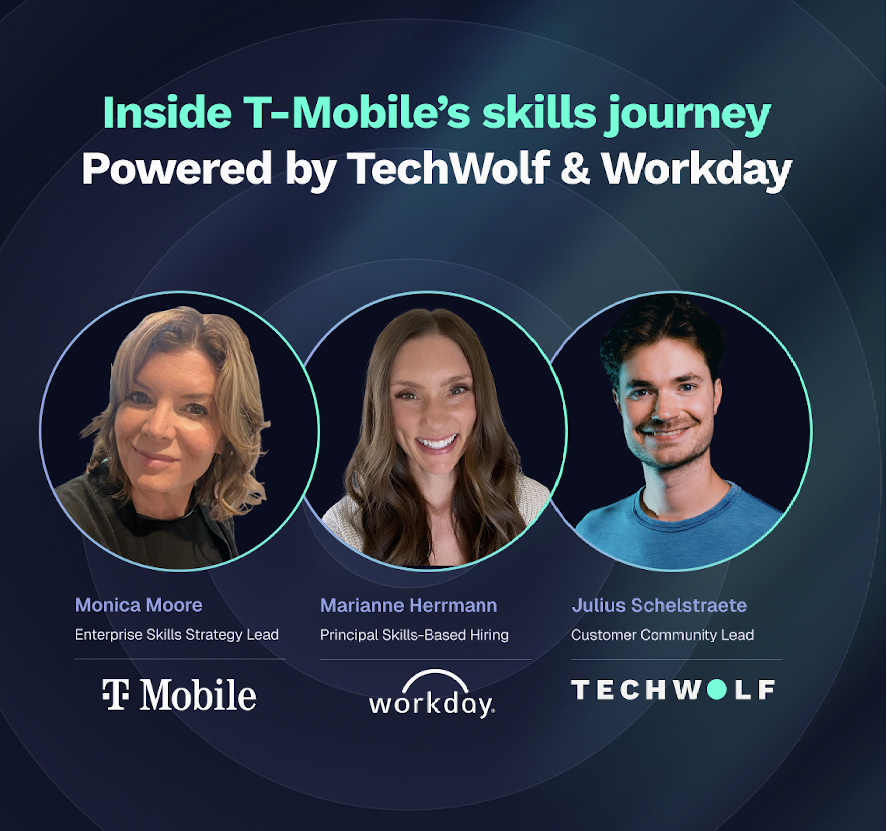
In June 2026, Monica Moore, who has led T-Mobile's enterprise skills journey since late 2023, joined a TechWolf and Workday webinar alongside Marianne Herrmann, Principal of Skills-Based Hiring at Workday, hosted by TechWolf. As a forward-looking talent leader, she opened the hood on T-Mobile's move from spotty, unusable data to skills and task intelligence across every job and every employee, and what the company is now doing with that data. This is a recap of that conversation. Watch the full session here.

TL;DR
T-Mobile went from spotty, unusable skills data to skills and task intelligence on 100% of its jobs and 100% of its people in less than six months, partnering with TechWolf. The foundation will feed three programs: skills-based hiring through Workday HiredScore, internal mobility through Opportunity Marketplace, and AI-impact workforce planning with its HR business partners. TechWolf sits underneath as the data layer, feeding the systems T-Mobile already runs rather than adding another screen for people to log into.
Business context: a telco becoming the connective tissue for AI
T-Mobile intends to stay at the top of telco while reframing what it offers the world, positioning itself as the connective tissue for AI. A shift that size only works if the workforce moves with it. Monica Moore, who has led T-Mobile's enterprise skills journey since late 2023, made an early bet to go all in on a skills-based approach, then brought in TechWolf in 2025 to put real data underneath it.
What started the program and what sustains it are now two different things. In 2023, the problem was data transparency: T-Mobile had no clear view of the skills it needed or the skills it already had, and no structure around either. In the age of AI, the question has moved from skills alone to how work itself gets done, which tasks can be automated or augmented, and what that means for every role. Skills became the enabler of that larger conversation rather than the whole conversation.
In this moment in time, it's less about skills and more about task intelligence and AI and the future of work and how work gets done. Skills is an enabler of that.”
— Monica Moore, leading T-Mobile's enterprise skills journey
Challenges: turning a blank page into a decision-grade foundation
Three hurdles stood between T-Mobile's AI ambition and a workforce it could plan around.
- No structure, no visibility. There was zero structure around skills at the start. Leaders could see the gap but had nothing to act on: no view of the skills each role required, and no view of the skills the workforce actually held. The early case for the program had to be made on intuition rather than data.
- Manual approaches were too slow and too expensive. Identifying the skills that matter for every job profile by hand takes most organizations 12 to 18 months. T-Mobile's own early skills pilot ran a consultant and subject matter experts at the IT function alone for roughly 12 weeks, at high cost, just to reach a recommendation. That pace could not keep up with the business.
- A role architecture in constant flux. T-Mobile started with about 2,500 roles and now sits at nearly 4,000, with new roles created continuously. Any foundation had to keep pace with that change rather than freeze a snapshot that would be stale within months.
We don't do skills for skills' sake. We do skills to meet business needs and solve business challenges.”
— Marianne Herrmann, about Workday's own journey with skills
How we helped: one data layer feeding the systems T-Mobile already runs
TechWolf connects three data sets that rarely live together: skills, work, and market intelligence. It infers them from sources the customer already has, then feeds the result into the systems people use day to day. For T-Mobile, that meant Workday. TechWolf is the backend data layer; Workday is the front end.
Trusted data. TechWolf inferred skills across 100% of T-Mobile jobs and determined which skills were critical for each role. Within three months, subject matter experts validated those skills through the TechWolf Console, covering more than 85% of all the jobs. In parallel, T-Mobile ran its Skills on People initiative, inferring skills on 100% of employees with no restriction, and inferred tasks across 100% of jobs. In under six months, the organization moved from spotty, unusable data to complete skills and task intelligence on its jobs and its people.
Executive insights. As part of TechWolf's early adopter program, every T-Mobile job and task is run through the Stanford human agency scale that estimates how much of the work can be automated, how much can be augmented by AI, and how much stays fully human. Combined with market data, this gives VPs and SVPs a data-driven starting point: where the automation and augmentation opportunities sit, which emerging skills and roles peers are building, and where the gap is between the workforce today and the one the strategy will need.
Embedded actions. The intelligence does its work inside Workday. Validated skills flow back to the worker profile. HiredScore uses the skills on jobs and people to match candidates by capability rather than by who happened to apply. The Opportunity Marketplace matches employees to internal grow-and-stretch assignments. HR business partners use the work intelligence, visualized in TechWolf’s Analyst Agent to prepare strategic workforce planning conversations with the business.
Claude might look at external data, but the proprietary AI that TechWolf has to infer skills on T-Mobile data, our people, how we work, what our specific jobs are, that is not public. It is internal data that is continuously being updated.”
— Monica Moore, T-Mobile
Outcomes: a foundation that already moves the business
Complete coverage in under six months
The headline outcome is speed at scale. In less than six months, T-Mobile covered 100% of its jobs and 100% of its people with skills intelligence and inferred tasks across every role. Subject matter experts have validated skills on 74% of jobs, and 84% of headcount now sits in a role with validated skills, beating the 80% goal in a single cycle.
We went from spotty, unusable data to complete task intelligence, skills intelligence on our people, and skills intelligence on our jobs, 100% across all of those fields.”
— Monica Moore, T-Mobile
What the speed unlocks
Speed matters because of what it lets the business do. The skills that once required a 12-week consultant engagement now happen in-house at the click of a button, so leaders can see a gap, spot an emerging skill, and decide whether to build or buy in the moment, rather than waiting months for a contract to deliver. Today, that speed already feeds learning and recruiting decisions, with the larger workforce planning calls maturing as the data moves from insight into action.
We're able to do that literally by the click of a button in partnership with TechWolf. We gain those insights so quickly that the business can move much, much faster. It's not only a time saver, but it's also a money saver."
— Monica Moore, T-Mobile
High confidence, even before full validation
Inferred data is only useful if leaders trust it. T-Mobile is seeing a 78% approval rate on inferred job skills and 90% on inferred people skills. That means even the roles still awaiting subject matter expert review carry close to 80% confidence, so 100% of jobs can feed directional workforce planning today rather than waiting for perfect data.
Three programs on one foundation
The same foundation now powers three programs at once. HiredScore matches candidates to roles on skills and sharpens visibility into internal talent, surfacing people who fit a role rather than only those who applied. Opportunity Marketplace, piloted last year and now rolling out, matches employees to internal projects so they can apply skills in new places and stretch into new ones. HR business partners use the task and AI-impact data inside TechWolf’s Analyst Agent to lead richer workforce planning conversations. The partnership effect shows up in Workday's own use of the approach, too: running skills-based hiring on its global revenue team, Workday reports that the people hired this way closed their first deals 14% faster.
Governance: confidence-weighted, employee-validated, built for change
With a role architecture that keeps moving, governance is what keeps the foundation trustworthy over time.
- A cross-functional skills committee. Compensation, recruiting and learning and development feed signals into a shared process: spikes in learning requests, hiring manager asks, and the compensation team flagging certain roles now need AI skills to be benchmarked and priced correctly. Those triggers drive a roughly quarterly review of which skills to add or retire, supported by views in the TechWolf Console of where peer and aspirational companies are seeing emerging skills.
- Confidence treated as a first-class metric. The 78% job and 90% people approval rates are watched, not assumed. Validation targeted high-incumbent roles first to reach broad headcount coverage quickly, and every newly created role triggers inference and review so coverage does not decay as the organization changes.
- Employee agency by design. Skills were inferred on 100% of people, but validation is employee-confirmed and was never mandated. T-Mobile folded it into year-end check-ins and goal-setting as a resource for better career conversations, which built trust organically. Enterprise validation sits around 32%, with back-office functions closer to 70%; the gap is concentrated in frontline retail and care.
Project challenges: the honest parts
- Thousands of small decisions. Standing this up at scale meant making on the order of a thousand calls, from how many skills to infer per profile to where to draw validation lines. The program only moved because leadership empowered the person running it to decide. Routing every choice through a steering committee would have stalled it before launch.
- Proficiency is still an open question. T-Mobile has a five-level proficiency framework but has not yet applied it to this work. The moment you tell people the skills they did not know they had, the next question is how good those skills are. The plan is to assess proficiency with TechWolf only for the critical skills where it changes a hiring or deployment decision, rather than every skill on every profile.
- Tasks inferred from job descriptions, not yet live work systems. Today, T-Mobile infers tasks from job descriptions. Monica's own recommendation to peers is to go further and use TechWolf’s ability to infer skills and tasks from the systems where work actually happens, such as GitHub, Jira and Salesforce, because seeing the real work is what builds business confidence in the data.
Next steps: from HR data to the flow of work
Several things are queued up, all building on the foundation already in place.
Proficiency and targeted assessments come first, activating proficiency levels in Workday and the learning systems for the skills that matter most. AI displacement modeling at the role level deepens, alongside learning in the flow of work that closes the gap between an employee's current skills and the skills their next role will need, without the employee having to chase it down.
The larger move is to extend the intelligence beyond HR and learning data into the business systems that drive outcomes, so TechWolf reads work signals directly and sharpens the picture of what people can do. As the foundation reaches further into real work, the insights get faster and more concrete.
Go all in, because then you can use the data on the other side much faster. Just get started, don't wait. The pace at which things are changing, if you wait any longer to start diving into skills intelligence, you'll miss the AI wave.”
— Monica Moore, T-Mobile
Let’s get talking
We believe great conversations lead to great solutions. Let’s connect and see how we can help.

%201.jpg)

SAP Successfactors
Degreed

Visier
Workday
ServiceNow

Workday
Workday
Visier
.avif)
Workday




.svg.avif)
SAP Successfactors

SAP Successfactors


SAP Successfactors
Degreed
SAP Successfactors

Workday