
Your workforce plan is already out of date


This year's AI layoffs follow an old pattern: companies make their biggest people decisions too late and all at once. Here's what's wrong with workforce planning, and what to do instead.
Companies are cutting jobs for AI before AI can do the work
In March, Canva co-founder Cliff Obrecht told staff that the pace of an AI lab half Canva's size was "the new bar." When people worried about their jobs, he deleted the post, and the company said it had no plans to lay off staff.1
Seven months later, on 4 November, Canva said it would cut, change or move about a fifth of its roles. Growth had slowed. In August, Canva had cut its revenue forecast, partly because running AI cost more than expected.3
"Small changes won't be enough."
Melanie Perkins, co-founder and CEO, Canva
Other employers are also cutting jobs and pointing to AI. The Dutch government has set a savings target that it expects will cut about 25,000 full-time civil service jobs by 2035. Its plan for how AI will help isn't due until early 2027.4 Barclays expects to cut about 5,000 jobs by the end of this year, and it has tied part of those cuts to AI.5
Some companies have already had to hire people back. Block cut about 40% of its staff, citing AI. Within weeks, it rehired some of the people it had let go.6 Many layoffs last year were blamed on AI, yet under 1% happened because AI had actually made those jobs unnecessary.7 That hasn't slowed things down: US employers have blamed AI for more than 120,000 announced job cuts so far this year, more than twice as many as in all of 2025.8
During the pandemic, many companies made the opposite mistake and hired too fast. Meta nearly doubled its headcount in under three years, then cut more than 11,000 jobs. "I got this wrong," Mark Zuckerberg wrote in 2022.
Hiring sprees and layoffs have the same cause: workforce planning is broken.
Where traditional workforce planning fails
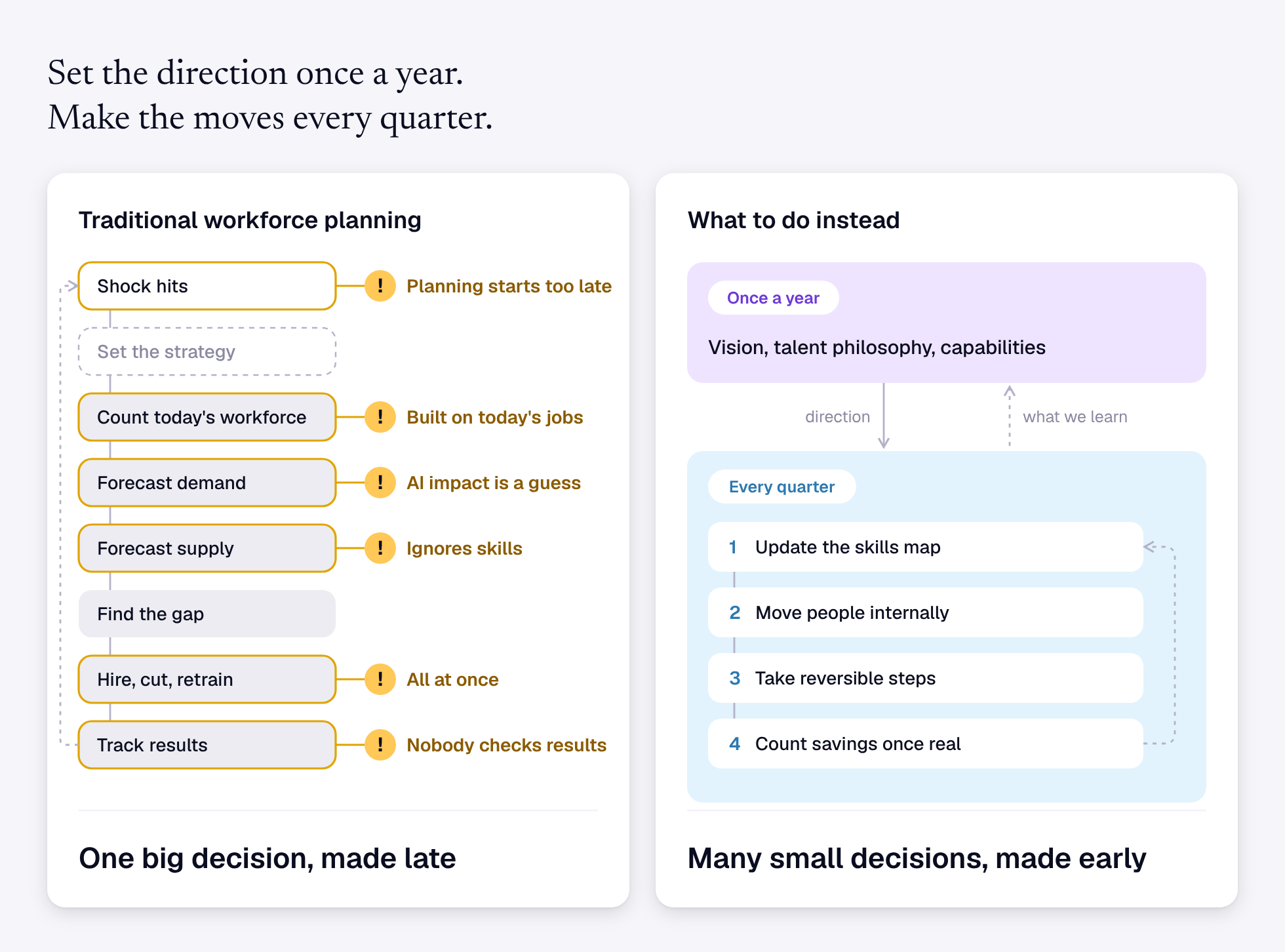
Most leadership teams know how traditional workforce planning works. Once a year, alongside the budget, you start from the business goals, take stock of the people and skills you have, and forecast what you'll need three to five years out. Then you find the gap between what you have and what you'll need, and close it by hiring, training or moving people into new roles.
This approach was built in the 1960s and 1970s, for a world of "relative economic stability."9 Today, AI changes what jobs involve within months, and most companies still plan the old way. Companies whose workforce plans keep up with how the work is changing are 1.4 times as likely to beat their revenue goals. Yet fewer than one in five CHROs say their company plans like that.10
Here's where it goes wrong:
- Companies start planning too late. Some only start after a big event, such as a merger, an acquisition or a major change program. By then they're under pressure to make big decisions fast, before anyone has worked out what it will take to get the work done.10
- Companies plan around the jobs they have today. Most start from today's jobs, skills and headcount, and only then ask what the strategy needs. So they end up protecting today's setup instead of building what the strategy needs. And even as AI changes the work, only about one in six CHROs say their company now updates its workforce plan more often than it used to.11
- Companies guess how much work AI will take over. A common shortcut is to score each role for how much of it AI could automate, then plan cuts from that score. But the score only shows what AI could do in theory. It doesn't show whether the company will use AI for that work, whether doing so will pay off, or whether the AI tools the company has can do it. Even so, in a survey this spring, 44% of US CFOs said they plan AI-related job cuts this year, even though the gains from AI aren't yet showing up in their revenue.12
- Companies count people and ignore their skills. Most workforce plans track how many people a company has and how many will leave. They don't track who already has the skills to take on new work. So when someone quits, the company often hires a replacement for the same job. Almost half of employers admit they refill the seat, without asking whether the business still needs that job.13
- Companies make big changes all at once. Most companies change headcount in big jumps. They leave it alone through the normal ups and downs of the business, and act only when the gap gets large, with a big hiring wave or a big layoff. A big cut made under that kind of pressure is usually blunt: it's sized to hit a savings number, so it doesn't look closely at which work is going away or which people the business will need next. Some companies set the savings target by copying what similar companies achieved, without working out what their own business can do without. And the savings rarely last: three years on, nine out of ten cost-cutting programs no longer show results.14
- Nobody checks the results. Few companies go back to check whether the changes they made to their workforce, such as cutting a team or retraining people for new roles, delivered what they expected. It's the same with AI. Executives believe AI has made their companies more productive, but the gains in their companies' own revenue and staffing figures are much smaller.15
What these mistakes cost
And big, late cuts are expensive:
- The people who stay get less done. Leaders often expect the people who survive a layoff to be grateful and work harder. In fact, they become less engaged and less productive. Studies have found that survivors take much more sick leave and are still less engaged years later. Your company-wide engagement score may bounce back, but only because the new hires weren't there for the cuts.16, 17
- Profits don't improve. Cuts rarely pay for themselves. Companies that cut end up less profitable than similar companies that didn't, and in fast-growing industries that spend heavily on research the hit is even bigger.18
These costs are easy to miss at first. When a layoff is announced, share prices dip only slightly, and even less when the layoff is presented as cost cutting or an AI restructure.19 The drop in engagement and the weaker profits only become clear months or years later.
"Many companies decide how many people to let go before they understand what it will take to get work done."
Gartner, October 2026
What to do instead
Companies still need to plan years ahead. They also need a way to act faster when the work changes.
Once a year, the leadership team should decide where the company is going and which capabilities it will need to get there. Every quarter, the leaders closest to the work should check how it's changing and take the next step. That way, the yearly plan sets the direction, and the quarterly check decides how fast to move and catches what the yearly plan got wrong.
Once a year: start from your vision and your talent philosophy
The yearly plan should start from the company's vision: what the business wants to be in three to five years. It should also start from the company's talent philosophy: how it wants to find, grow and keep its people, and how it treats them when the work changes. Together, they tell you which work will grow, which will shrink, and which capabilities you'll need. The leadership team should plan around those capabilities.
For example, a bank might decide that by 2029, a small business that applies for a loan gets a decision within a day instead of weeks. To get there, it needs AI that prepares the credit analysis, and people who are good at judging risk and advising the client.
- Rebuild your most important processes. Start from the value the business needs to deliver, then redesign the whole process to deliver it using the people, tools and AI available today (see our previous article). Pick the few processes that matter most to your vision, and commit to rebuilding them over the next few years. Only the leadership team can make that call, and it takes years to pay off, so it belongs in the yearly plan. The rebuilt processes then show which skills and roles you'll need.
- Build the capabilities before you need them. New skills take a long time to build, so start now on the ones your vision calls for. Set up the training, create the new roles and career paths, and keep hiring junior people every year, even when budgets are tight. Yet companies are already hiring fewer young people into the jobs AI can do: in the US, about 11% fewer 22 to 25 year olds work in those jobs than in late 2022. That means fewer people learning the work today who could lead it in ten years.20
- Stand by your talent philosophy. Give people a clear reason to build their career with you: what they'll learn, the work they can grow into, and how you'll help them get there. For example, promise everyone the time and support to learn the skills your vision needs, and a real path into the work that's growing. Say it inside and outside the company, and keep to it when budgets are tight. That's when people decide whether to believe you. If they do, your best people stay and good candidates want to join.
Every quarter: let the evidence set the pace
Every quarter, the leaders who run each part of the business, together with HR and finance, should look at how the work has changed: which tasks AI has taken over, where work has grown, and who could move. Then they should decide the next small move, such as which people to retrain or move, and which roles to stop hiring for.
- Keep a live map of work and skills. None of this works on job descriptions written years ago. You need an up-to-date picture of what tasks each role involves, which of those AI has taken over, what skills each person has, and where they could move next.
- Build an internal market for work. People also need somewhere to move to. Open every new role, project and short-term assignment to internal candidates first, and match people on their skills, whatever their current title. When people can see the openings and apply easily, they move to where the work is growing, and managers can't quietly hold on to their best people.
- Move people before the work disappears. When the map shows a role's tasks shrinking, start moving people into growing work right away, while there's still time to train them. Most companies wait until a role is cut and only then try to find people a new job, when it's usually too late. Moving people also costs less than hiring: outside hires get paid about 18% more than people promoted from within, and they perform worse for their first two years.21
- Move fast, in steps you can reverse. Big, irreversible cuts take months to plan and still go wrong. Small steps you can undo, like a hiring freeze or a new process in one team, can start next week. Check each one against two questions: is the work still getting done as well as before, and did AI really free up the time it was supposed to? If yes, take the next step right away. If not, undo it and try something else.
- Count the savings only once AI does the work. Often the expected saving is written into next year's budget long before AI is ready. Then teams have to cut people by a fixed date, whether the AI works yet or not. Budget as if you still need today's team. Lower the payroll line only once the new process is live and AI is measurably doing those tasks.
- Feed what you learn back into the yearly plan. One unusual quarter shouldn't change the yearly plan. But when the work changes much faster or slower than the plan assumed for several quarters running, update it right away, without waiting for next year's cycle.
Stop planning in a panic
This year's AI layoffs follow a pattern every leadership team has seen before. Companies wait, then make big decisions fast, under pressure, based on a forecast. The cuts are meant to improve results, but they often leave the people who stay less engaged and the company less profitable.
Instead, once a year, decide where the company is going and which capabilities it will need, and start building them now. Then, every quarter, let the evidence decide how fast to move: shift people as the work changes, in steps you can reverse.
The next time the work changes, your people will already be moving into the work that's growing.
Sources
- Clune, B. (2026, March 31). "This is a new bar": Cliff Obrecht sparks Canva job cut fears in since-deleted Slack note. Capital Brief.
- Van Boom, D. (2026, November 4). Canva layoffs impact 1,200 after design giant's 'hardest year yet'. Forbes Australia.
- Watson, M. (2026, August 5). Canva cuts revenue forecast following AI cost blowout. B&T.
- Rijksoverheid. (2026, October 26). Kabinet werkt aan slagvaardige overheid: eenvoudiger, slimmer en kleiner. Government of the Netherlands.
- HRD. (2026, October 22). Barclays cuts 5,000 jobs as it leans on AI to lower costs.
- Cointelegraph. (2026, March 19). Dorsey's Block laid off 4K employees last month, some are already back. The 40% figure is from Cointelegraph's 26 February 2026 report, "Jack Dorsey's Block to cut 4,000 jobs in AI-driven restructuring".
- Sharma, N. (2026, September 16). One-third of AI-replaced workers will be rehired by 2029: Gartner. CIO Dive.
- Challenger, Gray & Christmas. (2026, November 5). October layoffs at three-year low; seasonal hiring plans up 26%. The 2025 total is from the 2025 year-end Challenger report (2026, January 8).
- Reilly, P. (1996). Human resource planning: An introduction. Institute for Employment Studies.
- Gartner. (2026, October 28). Gartner predicts 30% of employees replaced by AI will be rehired by 2029 if organizations don't overhaul workforce planning.
- The Conference Board. (2026). CHRO Confidence Index, Q3 2026.
- Angelo, J. (2026, March 24). CFOs admit privately that AI layoffs will be 9x higher this year, and still a fraction of 'doomsday' predictions. Fortune, reporting the Duke CFO Survey.
- CIPD. (2026). Resourcing and talent planning report 2026.
- Agrawal, V., Nottebohm, O., & West, A. (2010, May). Five ways CFOs can make cost cuts stick. McKinsey & Company.
- Baslandze, S., Edwards, D., Graham, J. R., et al. (2026, March). Artificial intelligence, productivity, and the workforce: Evidence from corporate executives (NBER Working Paper No. 34984).
- Kivimäki, M., Vahtera, J., Pentti, J., & Ferrie, J. E. (2000). Factors underlying the effect of organisational downsizing on health of employees: Longitudinal cohort study. BMJ, 320, 971 to 975.
- Luc, K., & Jackson, F. (2024, March 6). Company layoffs: Dispelling 4 common myths. Culture Amp.
- Guthrie, J. P., & Datta, D. K. (2008). Dumb and dumber: The impact of downsizing on firm performance as moderated by industry conditions. Organization Science, 19(1), 108 to 123.
- Eshghi, K., & Astvansh, V. (2023). Stock investors' reaction to layoff announcements: A meta-analysis. Human Resource Management Journal.
- Stanford Digital Economy Lab. (2026, August). Canaries in the coal mine.
- Bidwell, M. (2011). Paying more to get less. Administrative Science Quarterly, 56(3).
Blog
From guides to whitepapers, we’ve got everything you need to master job-to-skill profiles.

Your workforce plan is already out of date
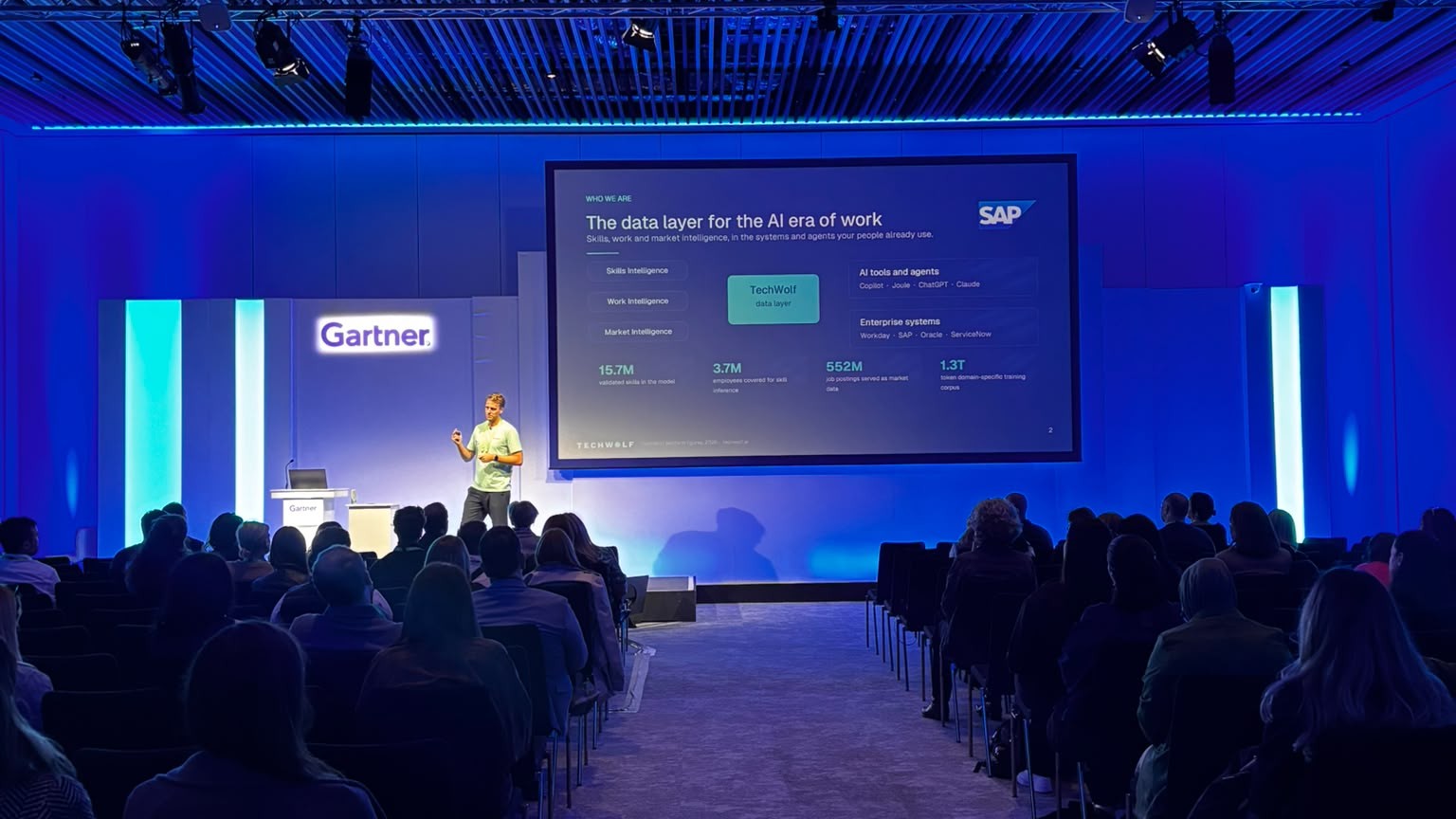
Gartner HR Symposium/Xpo™ 2026: our takeaways from London and Orlando



HR's time to lead, and the data to do it: our UNLEASH Paris 2026 takeaways