
The friction layer (Part 3): The engineers your AI programme may be missing
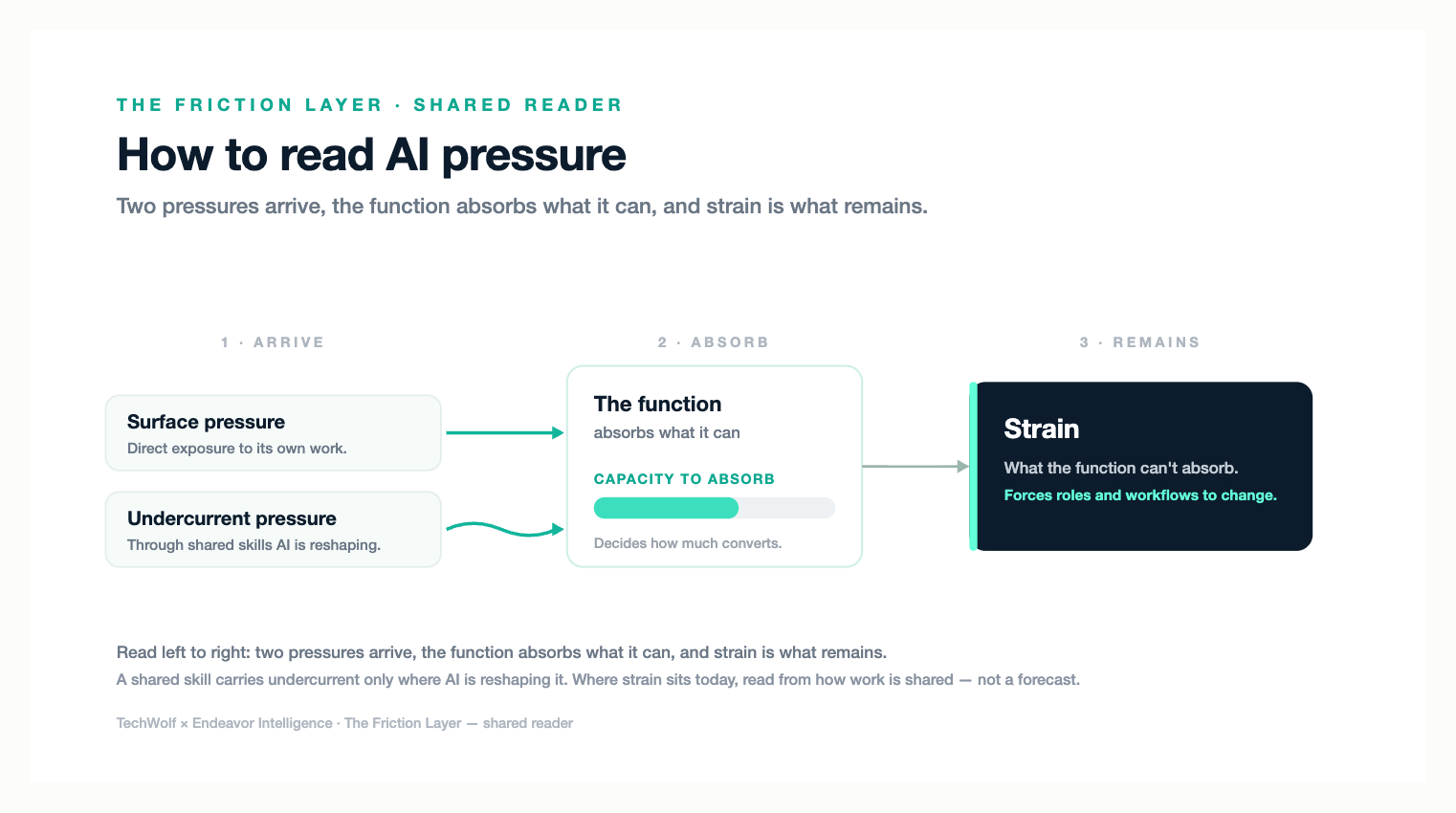
This is part 3 of the Friction Layer series, with TechWolf, by Markus Bernhardt, Principal at Endeavor Intelligence. The image provides an overview of how each blog post fits within the series:
- Part 1 mapped strain: the functions where it is heaviest.
- Part 2 and Part 3 follow the undercurrent, AI change that travels between functions through shared skills: Part 2 out of software engineering, Part 3 into electrical and embedded engineering.
- Part 4 will look at capacity to absorb: how much room a function has once that change arrives.
This piece can be read on its own.
TL;DR
Does your AI programme reach everyone whose work AI is changing? AI change travels between functions through the skills they share, and a programme drawn along the org chart can stop where those skills do not. If you build physical products, your electrical, embedded and firmware engineers are a case in point. Taken as a group, they are partly software engineers by skill: over 40 percent of the AI change reaching them through shared skills comes through software-development skills. Most of that sits with the embedded and firmware roles, the engineers who write the code inside the product, and those roles can sit with hardware on the org chart. Check whether they are inside the tools, training and reskilling you have built for software.
Where the org chart and the skills disagree
Every function meets AI in two ways: through its own work, and through the skills it shares with other functions. When AI changes what a shared skill can do, that change reaches every function that uses the skill, whether or not anyone aimed a tool at them. The first route follows the org chart. The second does not.
An org chart is a floor plan: it shows the rooms and what happens in them, but not the structure the floor shares with the storeys above and below, or the load that structure carries. Shared skills are that structure, and the AI change arriving through them is the load the plan leaves out.
So a programme drawn along the org chart, with its tools, training, and reskilling, can stop where shared skills do not. The data cannot tell you whether yours does. It can tell you where to look, and this piece focuses on one group: the electrical, embedded and firmware engineers in a business that builds physical products.
As a group, your electrical and embedded engineers are partly software engineers
Look at the skills employers ask for in job postings for the people who design circuit boards, controllers and the firmware that runs them, and a good part of that engineering reads like a software discipline.
The group here is three job titles: electrical engineer, embedded software engineer and firmware engineer, and it is not uniform. Embedded software and firmware engineers write software for a living. They do a little under half of the work the data attributes to the group, but take about three-fifths of the AI change reaching it through shared skills, and most of their share comes through software-development skills. For electrical engineers on their own, only a small part comes that way; the largest contributors to theirs include project and people management and electrical skills, different shared skills that this piece does not follow. What follows is the group's result; the embedded and firmware roles carry most of it, and they are where to look first.
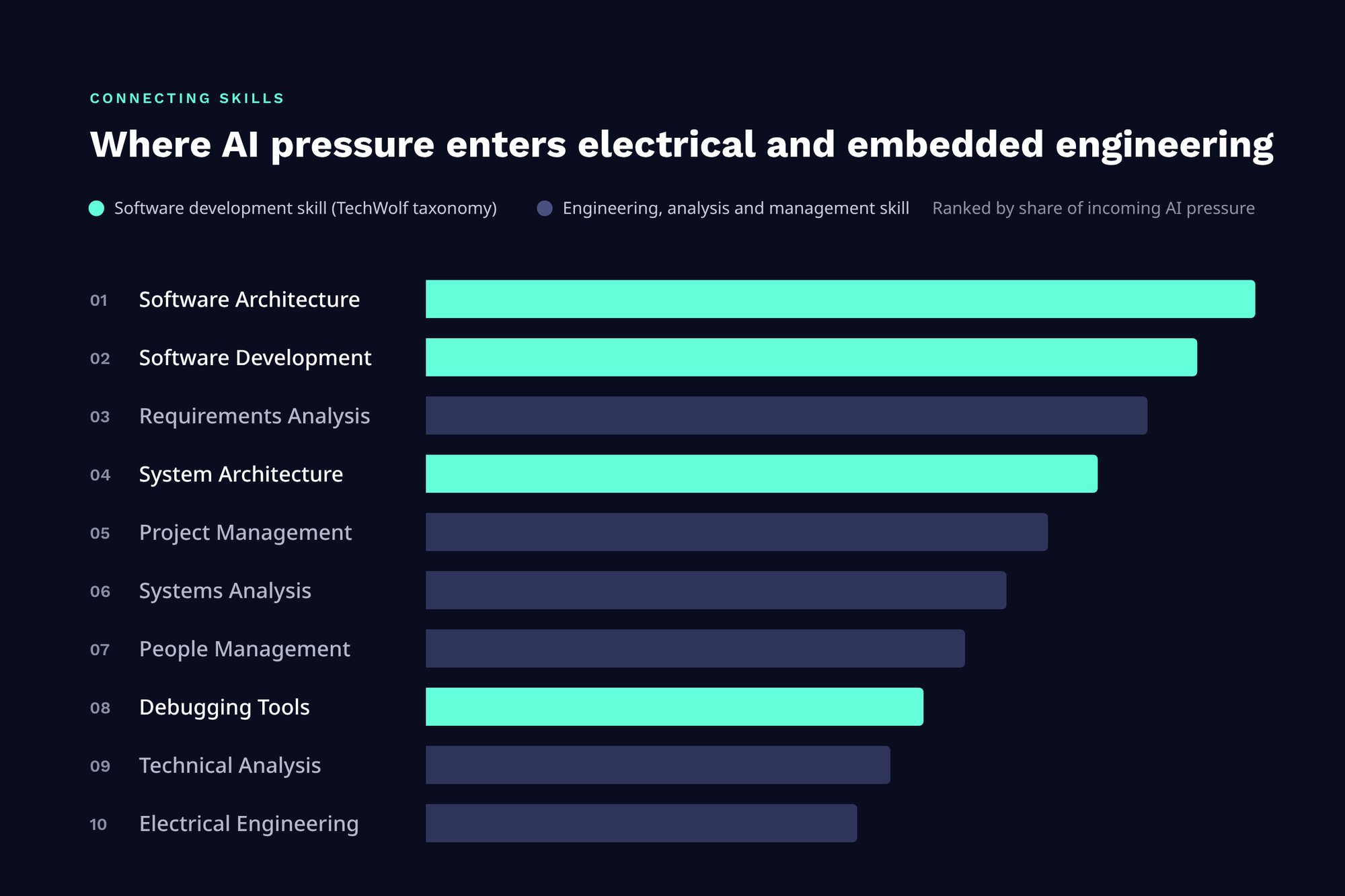
Rank the skills by how much of the AI change reaching the group through shared skills each one carries, and software leads. Software architecture and software development come first and second, system architecture fourth and debugging tools eighth. That is three software-development skills in the top six.
Put plainly: of all the AI change reaching this group through skills it shares with other teams, over 40 percent comes through software-development skills. That is the largest single block, and it comes through skills an org chart would file under software, not hardware.
The finding is about software-related skills inside electrical and embedded engineering, next to the physical work. It is not about all hardware work. Mechanical and hardware engineering roles are a separate group in this analysis. What makes it a leader's concern is the route: part of the AI change reaching these engineers arrives through skills they share with software teams, whatever the org chart says.
Job titles draw a hard line between hardware and software engineering. Skills draw a much softer one. An embedded engineer and a software developer look like different worlds on an org chart, yet in the skills each role calls for, a good part of the ground is shared. That overlap only becomes visible when you measure work at the level of skills, a resolution job titles cannot give you.
— Jeroen Van Hautte, CTO at TechWolf
What to check on the people side
On an org chart these engineers can sit with hardware, a long way from application software, and much of the work itself is physical and tooling-heavy, from thermal limits to factory equipment. Where a company manages hardware and software separately, an AI programme built for software, with its tools, training, rules, and reskilling, can stop at the software org, and these engineers can fall outside it. The embedded and firmware teams are the first place to look: they write software for hardware, so wherever a company draws the line between the two, it runs through their work.
Measured by job ads, roles like these are also few next to software. In TechWolf's US postings data for 2021 to 2026, electrical, embedded, firmware and hardware titles together make up about one in twenty engineering job ads, against about one in six for software and application titles.
These are questions to put to your own organisation. Each one marks a point where an AI programme drawn along the org chart could stop short of these engineers. The data shows the skills overlap. It cannot show whether yours does, but people inside your company can.
- Are embedded and firmware teams inside the scope of the AI tools and training you have built for software, or outside it because they report through hardware?
- If they are in scope, does what you offer fit them: the same AI tools and courses as application developers, or a version adapted to firmware work and, where it applies, its safety rules?
- When you size AI-related reskilling, are these engineers counted?
- Do separate hardware and software academies, career frameworks or job architectures treat these roles as hardware, when postings for these roles ask for skills that overlap substantially with software?
- Does the overlap open an internal path from embedded and firmware roles into software roles, and if so, do your career frameworks show it?
- Who owns AI capability for these engineers: engineering, HR or the AI steering group?
You do not need all six answers to act. Any answer that leaves these engineers short, or that nobody can give, marks a place where your programme stops.
Do the review habits travel with the skills?
What follows is my hypothesis, and the data does not test it; the overlap is what makes it worth asking.
Many software teams are finding that AI-written code can look right and still be wrong, and are building habits aimed at that kind of mistake: review tuned to machine output, test suites that assume the author may be confidently wrong, and the reflex of checking a fluent suggestion against a fixed standard, such as a test or a specification.
Physical-systems engineering has its own verification standards, around safety and physical testing, that are often stricter than mainstream software's. They were largely built around a different kind of failure, though some may already reach machine-generated code. I hypothesise that the AI-specific habits do not necessarily come with the skills. If so, the same kind of AI change could meet a different set of checks in embedded and firmware work than it meets in application software.
The check is concrete:
- Pick one physical-systems workflow that matters to you, such as controller firmware or the embedded code in a product.
- Trace where AI-generated software enters it.
- List the existing checks that apply to that output, and ask whether any of them were designed with a machine author in mind.
- Name who accepts the result before it reaches hardware.
What I would want to know, in any business that builds physical products, is whether the review habits built for machine-written code reach the embedded and firmware work too, or whether the existing safety checks already do that job. If the existing checks already cover it, you have confirmed something worth knowing. If they do not, you have found where to start.
None of this is a forecast of job losses; it reads the shape of the work as the data captures it. The shared exposure alone is reason to bring the electrical and embedded side of the business into the same AI governance conversation as software, starting with the embedded and firmware teams, rather than treating it as a separate hardware matter. Whether your programmes and checks reach them is one question, and one you can answer yourself. How much room a function has once AI change reaches it is another, and the last piece in the series takes it up.
Appendix: How this analysis works
In short: job-posting data on 2,500 skills, with each task sorted by what AI can do with it, read through the skills functions share with one another.
TechWolf's Skills Intelligence Index maps 2,500 skills across seventeen job families, drawn from more than two billion job postings at over 1,500 companies between 2015 and 2025. AI impact is scored using TechWolf's own operationalisation of the Stanford Human Agency Scale: the underlying scale is a survey instrument, and the three-way sorting of each task into work that stays human-led, work AI can augment, and work AI can automate is TechWolf's; the structural analysis is Endeavor Intelligence's own, applying the method published in The Undercurrent in Data, with no editorial control by the data provider.
Incoming pressure is this series' name for AI change that reaches a function through the skills it shares with others. It counts the part of a function's work AI can augment, doing it alongside a person, weighted by how widely the skills behind that work are shared with other functions. Work AI can handle with minimal human input sits outside it, and work in a skill that stays human-led, or that no other function uses, carries almost nothing across. It is read per unit of work, so a large function does not score higher just for having more work.
The measure reads exposure from shared skills; it does not observe code or policies passing from one team to another, and review habits are not an input. The skills ranking shows how much of the family's incoming pressure each skill carries, using TechWolf's skill labels. Weighted across all skills, those labelled software development carry more than two-fifths of it, nearer half if one skill with an ambiguous label is counted among them, and all information-technology skills together, software development included, just under half.
Read per unit of work, the electrical and embedded engineering family takes in more incoming pressure through shared skills than software engineering does by the same route. That compares what arrives: in total, software engineering still has by far the most AI-touchable work, and on strain it sits well down the ranking, as Part 2 showed, while whether this group ends up more strained than software is a closer, unsettled question.
Electrical and embedded engineering here is a defined family grouping electrical engineer, embedded software engineer and firmware engineer titles; mechanical and hardware engineering roles sit in a separate family. The embedded software and firmware titles account for a little under half of the family's task signals and about three-fifths of its incoming pressure, so the finding concerns software-related skills within physical-systems engineering, not all hardware work. The pressure share, like the split by title in the body, divides the family's own result by title, keeping each skill's sharing weight at its value for the family as a whole: it shows where the result comes from, and only approximates how each title would score as a group of its own. The grouping matters. Moving the embedded software titles alone into software engineering leaves the family marginally above software; moving both the embedded software and the firmware titles, which leaves electrical engineers on their own, reverses the comparison at the baseline, though in a closely related allocation test that narrower result proved much less stable than the original one. That asks a different question of a narrower population; it does not show the original grouping to be wrong.
The direction of the comparison with software engineering held in the large majority of allocation tests, which vary how shared tasks are divided between families. Those tests hold the family definitions fixed, so they establish allocation robustness, which is a different thing from robustness to how families are defined; the regrouping above is the relevant check on that. The index is a snapshot and does not show when the skill structure described here formed.
The job-ad shares come from TechWolf's postings data for the US, 2021 to 2026 (the latest year partial), sorted into title groups drawn up for this question. Those groups do not cover every title and do not match the job family used above; they include hardware, electronics and FPGA engineer titles. This is a different source from the Skills Intelligence Index used for the rest of this analysis, and the shares count job ads, not people.
It is a directional analysis: it shows where AI pressure concentrates and how functions connect, not a precise ranking, and exact positions move with the modelling choices. It is not a forecast of job losses.
This analysis was co-published with Endeavor Intelligence.
Further reading. This piece sits third in a series of four. The friction layer: Where structural AI pressure actually lands looks at where AI pressure lands hardest across an organisation. The friction layer (Part 2): Why the most AI-exposed function isn't the most strained shows why software engineering, the function with the most AI-touchable work, sits well down the strain ranking. A final piece asks what decides how much room a function has once that change arrives. This piece can be read on its own; Parts 1 and 2 give the wider picture.
Blog
From guides to whitepapers, we’ve got everything you need to master job-to-skill profiles.
The friction layer (Part 3): The engineers your AI programme may be missing


Gartner HR Symposium/Xpo™ 2026: our takeaways from London and Orlando



HR's time to lead, and the data to do it: our UNLEASH Paris 2026 takeaways